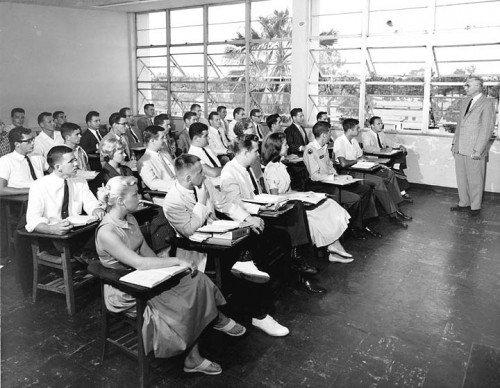
We’ve had a bunch of pedagogy posts recently from inside the creative writing classroom, from the professor’s point of view. I thought it would be pretty cool to let some students chime in. And as luck would have it, I happen to have access to a bunch of MFA peoples (at New Mexico State), because I’m professional like that. So, last Thursday night, during my 500-level Form & Techniques in Fiction class (themed Constrained Prose), I put out my laptop and posed the following questions:
Can you teach creative writing? How? How would you teach creative writing that is different from your MFA? How would you “innovate” or “renovate”? What have you “learned” from your MFA? What has been the biggest surprise? Disappointment?
Below, you’ll find the responses. If you have other questions you’d like discussed/answered, this will be an on-going segment for me, so shoot me an email or something.
READ MORE >
Behind the Scenes / 12 Comments
October 10th, 2011 / 1:44 pm
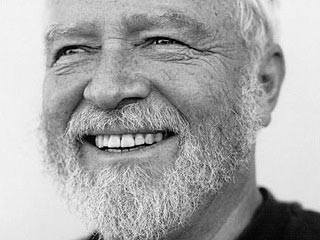
This Wednesday, October 12, 7–9pm, at the KGB Bar, NYC. Hosted by Louffa Press in celebration of Steve’s new fiction broadside:
The native New Yorker has threatened to bless us with his world of experimental fiction, flying all the way from Denver to woo his audience with tales of personal mishaps with traditional jazz legend Louis Armstrong, plants that grow human body-parts, cautionary tales of the electric fence, the unswerving wisdom of Italian prostitutes and old school New York City.
The broadside (Slave Husbandry) is a limited numbered edition of 50, handprinted on swarthy yet sophisticated recycled artisan paper, inked and pressed on the Vandercook Universal One letterpress. The large format broadsides (19″x12″) will be available at the event for your enjoyment and (italics) for your pleasure.
Also reading will be David Moscovich, Eileen Myles, Ted Pelton, and Mike Topp. It’s free and I wish I could be there. More info about Steve and the other readers after the jump…
READ MORE >
Events / Comments Off on A Night With Steve Katz
October 10th, 2011 / 12:48 pm
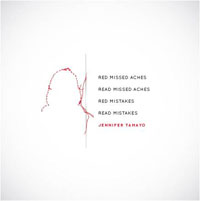 Red Missed Aches Read Missed Aches Red Mistakes Read Mistakes
by Jennifer Tamayo
Switchback Books, 2011
88 pages / $18 Buy from Switchback Books
If “flesh is the reason oil paint was invented” as de Kooning claimed, then the natural antithesis of oils are collages, and it seems no coincidence this method is increasingly popular in art and literature as the materialization of an ideal smooth whole flesh feels rejectable in this era of multi-medium hybridity. Where a lens is fragmented so fragments the subject even beyond lenses; and tidy categories of language, race and gender follow, as in Jennifer Tamayo’s collection of poems/images in Red Missed Aches Read Missed Aches Red Mistakes Read Mistakes.
READ MORE >
3 Comments
October 10th, 2011 / 12:00 pm
“A script is to a movie as a blueprint is to a building,” he said. “So many of the things that will later be major, visceral aspects of the storytelling — cinematography, music, sound effects, costume, performance, the rhythm of the editing — are only just indicated or assumed, and will be realized by a team of talented collaborators. The fiction writer has to serve all those functions alone, with his prose, selecting information so a handful of notes let readers hear the symphony. A screenwriter creates potential — a novelist has to fulfill it.” –from Up Front
Power Quote / 2 Comments
October 9th, 2011 / 2:55 pm
1. Charles Napier isn’t the only one who’s left us: Frances Bay passed away last month. No creamed corn was served at her memorial service.
2. My mentor Curtis White wrote something pretty pessimistic at Lapham’s Quarterly about the future of literature.
3. I wrote something a little more optimistic about why originality isn’t all that important.
Roundup / 25 Comments
October 8th, 2011 / 8:42 pm
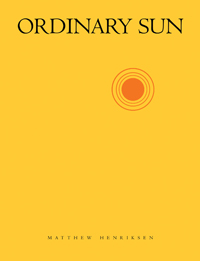 Ordinary Sun
by Matthew Henriksen
Black Ocean, 2011
120 pages / $15 Buy from SPD
Matthew Henriksen’s book, a beautiful yellow with a lovely orange orb on the cover, is aptly named, and when I first read it, I thought: “Blake! William Blake!” And of course, I was not entirely wrong, for Blake’s vision, his sense of wanting the writer to be essentially Romantic, revolutionary and ultimately Christian (though in an idiosyncratic way) is part of this book’s ethos. But to assume that one poet—now just a name to many—can influence a complex and intricate book about waking and sleep, vision and its oblivious counterpart, is perhaps misguided. On rereading, I find echoes of the canon and what also is not included there; I find places where Henriksen’s guided eye finds a way to relish the negative, and I think of theory, just a little: the series of “short-circuits” that someone like Slavoj Žižek would want us to find in something like a parallax view, the view “from both sides” of a picture or a noetic gap. This is what I think Henriksen is doing, ultimately, and I relish the intricacies of such poems that wonder with presence and absence inextricably connected by the beauty of the images that Henriksen employs. “What is love but a negative collaboration?” (“Afterlife Ending as a Question”).
READ MORE >
4 Comments
October 7th, 2011 / 12:00 pm
