Reviews

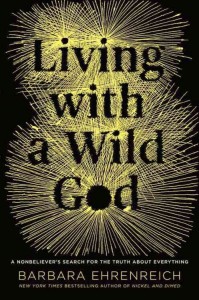
Living With a Wild God by Barbara Ehrenreich

9781455501762_custom-710bd13a0cbae3aa14f7cad9b0d0c0402b0305d7-s6-c30Living With a Wild God: A Nonbeliever’s Search for the Truth about Everything
by Barbara Ehrenreich
Grand Central Publishing, April 2014
256 pages / $23.50  Buy from Amazon


The first thing I read about Barbara Ehrenreich’s Living With a Wild God, out last month from Hachette Book Group, was the Amazon blurb. There was no question about whether I would read a book by Ehrenreich (Nickel and Dimed, Bait and Switch); she has already, for my money, proven her inherent cultural worth, despite the fact that I don’t always find her arguments entirely convincing. I turned to the blurb merely to identify the topic of this latest offering, and, since my mind was already made up to buy it, I skimmed. A few phrases jumped out, namely “In middle age, she rediscovered the journal she had kept during her tumultuous adolescence…” and “bringing an older woman’s wry and erudite perspective to a young girl’s impassioned obsession…” Those bits, along with the book’s subtitle (“A Nonbeliever’s Search for the Truth About Everything”), were enough for me to imagine the scope of the entire book, which went something like this: Teenaged Barbara keeps a diary that asks questions like “Is there really a God?” and “Should I go to second base with Steve C. after homecoming?” Older Barbara rereads this sweet, mortifying relic and brings some hard-won, grown-up wisdom to the whole ordeal.

I could not have been more off base (or, perhaps, worse at skimming). Living With a Wild God does include small excerpts from some of Barbara’s papers, but calling them a “diary” would be a real stretch, as would calling Barbara anything as conventional as a “teenager.” Barbara was exceptional (her father claimed to have an IQ of 187, and though she says this “put the rest of us at the level of insects by comparison,” you certainly get the sense that she didn’t fall too far from the tree), and her teenage papers are filled with commentary on things like quantum mechanics and the work of Sartre, Camus, Nietzsche, Tchaikovsky, and Borodin (just to name a few). At the age of 15 or 16, she becomes particularly taken with chemistry, summing up the obsession like this:

I am a supersaturated solution, I’m a filter paper who’s had too much. Chemistry is the last thing I think of at night and at 6:30 AM my first conscious thought is about the occurrence of aluminum. And this is only the introduction to the preface to the beginning of the most elementary chemistry. It’s not blood in my veins, it’s a colloidal suspension.

It struck me as I was reading that adolescent Barbara is a dead ringer for Paloma Josse, the twelve-year-old heroine in Muriel Barbery’s The Elegance of the Hedgehog. Both young ladies ask, via their notebooks, “What’s the point of it all?” While the question is common, these two are actually smart enough to take a serious, multi-disciplinary stab at an answer. Both find that answer to be, at least at first, fairly bleak.

One gets the sense, though, that Paloma, despite her suicidal plans, is going to be okay. Structurally, Barbery makes it clear that the child is working her way toward the lonely concierge Renée, and Paloma exhibits just enough childish thinking to lighten the mood. I spent most of Living with a Wild God, however, wanting to give young Barbara a cup of hot chocolate and a big old hug. Her childhood is atrocious. Her parents are hostile alcoholics who value “rationality” above all else, including—it seems—love. With a home life like that, it’s no wonder she became a solipsist at 14.

READ MORE >

1 Comment
May 16th, 2014 / 10:00 am

HTMLGIANT Features

Janey Smith’s SUMMER READS

Janey Smith HQ

Summer Reads continues w/ Janey Smith…

***

Content Warning: Six Books You Shouldn’t Read | Janey Smith

Janice Lee asked me to list six books that everyone should have on their summer reading list. Warning: These books will not affect you in any way.

182093371. Cubed: A Secret History of the Workplace by Nikil Saval (Doubleday, 352pp)

Nikil Saval has written a book about the secret history of office work, which is great because tedious, numbing work and near total isolation make my day—five days a week. To be honest, I really like office work. Like so much of social life, it’s a lot like acting. It’s repetitive and I know exactly what I’m going to get if I behave a certain way. Besides that, I like to copy people and the things they do. I make awkward postures all day. When someone asks me how my day at work was I always say the same thing, “I don’t remember.” That’s what makes office work so great. I don’t remember any of it. I mean, I do remember some things like where I put my stapler, but I do the same thing everyday. I hear people say that office work is so boring but it’s not. When I’m at the office I daydream a lot and I always think of things to do that are bad. I really like office work. Without it I would never get bored.

gi-retrospective_F2. General Idea: A Retrospective 1969-1994 (jrp | ringier, 224pp)
Most of the time I have no idea what art is. So it’s nice to know that Felix Partz, Jorge Zontal, and AA Bronson had a general idea of what it was. Eschewing a politics of identity and freed from the tyranny of individual genius—they considered themselves a trouple—General Idea took credit for everything it did as if it were one body, and not three. Furthermore, most of their shows were free. General Idea was really great. They understood that to be a great artist you had to be glamorous, act famous, and mix up fiction and reality. Everybody seems to think that you have to make things to be an artist but you really don’t. All you have to do is host beauty pageants, paint poodles blue, and put AIDS posters up in your neighbor and you, too, can be an artist. The best thing about General Idea is that they adopted a generic identity, which is great because to have no personality—or even multiple ones—is better than to have one personality.

486723. I’ll Be Your Mirror: The Selected Andy Warhol Interviews Edited by Kenneth Goldsmith, Introduction by Reva Wolf, Afterword by Wayne Koestembaum (Carroll & Graf, 428pp)
I really like Kenneth Goldsmith. He takes all the things an office worker does and uses that to make poems. And like most office workers he dresses really badly, which is great because poets get a bad rap for spending all their temp-job money on expressive clothes. But anyway, did you see that costume he wore at the White House? If I were president of something, I would have had him arrested for crimes against mundanity. It was really that bad. A total fashion atrocity. Goldsmith resembled a circus clown on LSD, which would have been really great had he done something incendiary to tip the scales in the war on income inequality. Instead, he read a poem about a bridge. Governor Christie seemed pleased. I’ll Be Your Mirror is a great book—thirty-seven selected interviews with Andy Warhol, each one demonstrating Warhol’s art of giving an interview—but Goldsmith should look in the mirror once in while and say, “No. I’m not going to do it,” and put his pajamas back on and pretend it’s the 1990s. Or better, hire a fashion consultant—someone, like Vanessa Place or Kate Durbin, who knows how to dress—after all, he can afford it with his professor’s salary.

97802627202504. Bill Viola: Reasons for Knocking at an Empty House: Writings 1973-1994 (MIT, 300pp)

Anytime Marjorie Perloff praises someone I want to remind her that I love wigs as much as Nada Gordon but Perloff’s no Andy Warhol and that mop atop her head looks awful. (To be fair, I acquire almost anything Perloff’s name is associated with.) The only reason I picked up this book is because Bill Viola writes about a cow on page 86.


tumblr_mwiqgbZ70p1royaq8o1_12805. Black Cloud by Juliet Escoria (Civil Coping Mechanisms, 138pp)
Juliet Escoria writes really great stories about summer romances. The formula is simple: Two people meet, they do all this crazy fucking, then everybody’s throwing up and screaming at each other. What’s neat is that the drama of heavy drug use which makes every story in this collection seem like a trailer park debutante ball obscures the mental illnesses that so many of the characters suffer. And so, in a way, it reminded me of Facebook: a fiction that advertises its characters illnesses in such a way that it’s easy to like it. But something else really important—something like office work—is also going on here: Juliet’s book is like a play, or a bunch of skits, like something we do when we’re at the water cooler at work except in Juliet’s play nobody is acting and everyone is falling apart. I asked Juliet how she wrote her book and she looked at me and didn’t say anything. When I asked her what time she gets up in the morning she said early. When it gets really late at night and I’m on drugs I feel sick. I think black clouds are beautiful.

productimage-picture-on-being-blue-a-philosophical-inquiry-3786. On Being Blue: A Philosophical Inquiry by William H. Gass (nyrb, 91pp)
William H. Gass is a famous intellectual. On Being Blue is an entire book about the color blue, which is great because somebody is going to have to know how to put blue back together after the oceans and the skies disappear. What’s funny is that I didn’t feel anything when I read this book. When I see blue I kind of go blank. So, while reading this book I also went blank. It was a great book. Now I know why I like to stare at the sky for a long time. It’s so ugly. One time I tried to think of something and I couldn’t think of anything. The only time I’m sad is when I don’t have any money. Being blue is something like that. There’s a whole ten pages on pubic hair. The best kind of philosophical inquiry is one with lots of fucking. This book is mostly porn. The cover is purple.

***

Janey Smith is a writer in San Francisco. His work will appear in the anthology 40 Likely To Die Before 40: An Introduction to Alt Lit. He hosts Live at 851: A Reading Series in San Francisco.

1 Comment
May 16th, 2014 / 10:00 am

Reviews

On Exactitude in Non-Library Science

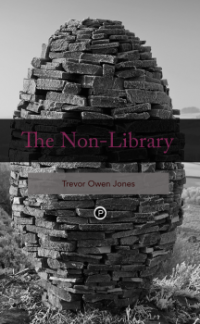
Jones_Non-Library_Cover_WEB-216x350The Non-Library
by Trevor Owen Jones
Punctum Books, 2014
104 pages / open-access (e-book), $11.00 (print) buy from Punctum Books
Rating: 9.0


Dear T.,

Already a few years ago now you composed a correspondence to mark the appearance of Judith Schalansky’s Atlas of Remote Islands: Fifty Islands I Have Never Set Foot on and Never Will. I return to that correspondence, on the publication of your first book, The Non-Library, because to do so seems to me somehow apposite. That may be the reason I find myself writing to you, to try to understand my sense of just why. READ MORE >

1 Comment
May 15th, 2014 / 1:15 pm

Reviews

5 Points: Boo, The Life of The World’s Cutest Dog

boo cover

1) The first thing that blew me away when I returned home from Brooklyn and greedily opened my Boo (which was waiting for me along side biographies of Shakespeare and Jonson) was the sheer Whitmanesque charisma and scintillation of it all: the big-heated spirit, the boundless energy , the Joie-De-Vivre. And yet, also, I was amazed by a stealthy and shrewd persona. A veritable host of personas! But, all in all, loveable. Absolutely loveable.

I had to rub my eyes once or twice, I admit, and scratch my ass, pensively, and then return to the bounties of the book to see if it was all for real. I mean, how could it be ?? … But, Yes! Yes! Yes! … Look, for example,  at how Whitman’s “I lean and loaf at my ease” translates, and upgrades even, so seamlessly, to Boo’s elegant and contemporary “I like to lounge around the house.”

And, delightfully, also, there is something tremendously naughty in the way Boo enchants us with his insouciance. His lazy wisdom. His casual control of self and universe. It is indeed impressive. And quite enchanting. Intoxicating. And heady…..Yes, folks hungry for the “real deal”, Boo is here. And he is a game changer. One for the cannon. Or one, really, round which the cannon rebuilds and redefines itself.

Boo grass

2) The most important question the serious student or master of literature must ask when measuring a candidate up against Walt Whitman, the Titan and father of American Literature, is “Does the subject contains multitudes??”

And indeed Boo proves over and over to be multitudinous READ MORE >

14 Comments
May 15th, 2014 / 9:00 am

HTMLGIANT Features

Juliet Escoria’s SUMMER READS

juliet_escoria

Juliet Escoria’s summer reads.

***

103Normally Special by xTx

I’ve read a ton of xTx stories online and I really loved Billie the Bull but I hadn’t yet picked up this collection. I read with her last week and I gave her an ELO CD as a present. She gave me this book in return. I was reading it on an airplane earlier today, but in the way that I normally reserve for good poetry, which is reading everything slowly and multiple times. Most of the stories are really short, so it seems like the kind of thing that would be good to read while sitting on the grass in the park but only if you want to feel a lot of feelings.


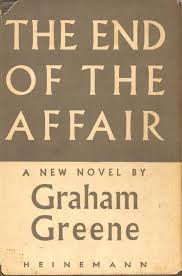
indexThe End of the Affair by Graham Greene

I read this last summer and it really stuck with me. This book is incredibly precise in its language and structure, which is something I can really get behind. The ending broke my heart, which is what the endings of all novels should do.


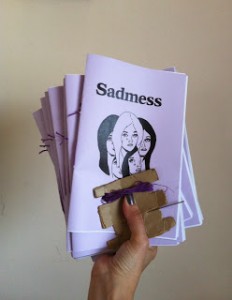
photo 4-1Sadmess by Ana Carrete

This is actually a chapbook. If you pick it up and flip through it, you will be drawn in by the cute little pictures and macros. If you start to read it, the poems will seem light and maybe even frivolous, like eating cotton candy, but this is a false sense of security. Ana has this way of stabbing you when you’re least expecting it that makes the pain that much more intense. This book is little and light so I guess you could pull it out of your bag to read while you’re waiting in line to buy cotton candy?


dangerous-angels-weetzie-bat-books-francesca-lia-block-paperback-cover-art1Dangerous Angels by Francesca Lia Block

I flew through this series as a teenager. I read it a few weeks ago to see if it still held up, and I flew through it that time too. It’s perfect to read if you are secretly a teen girl or are actually a teen girl or just like stories full of magic and heat and punk rock and Los Angeles.


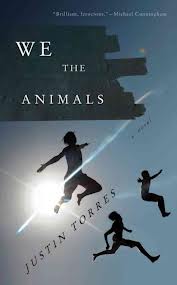
indexWe the Animals by Justin Torres

Summertime is a great time to read stories about underage sexuality and child abuse. The sentences are full of music and jangly edges in a way that makes me jealous.


***

Juliet Escoria is the author of Black Cloud, which is a collection of stories, videos, and pictures that was published by Civil Coping Mechanisms this past April.

1 Comment
May 14th, 2014 / 10:00 am

Yuriy Tarnawsky visits Chicago

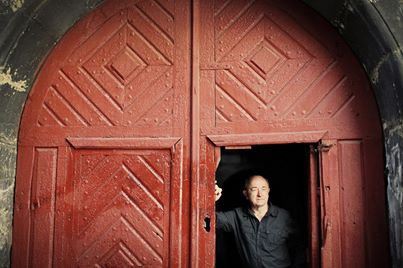
Yuriy, peering through the doorway to Chicago

Yuriy, peering through the doorway to Chicago

This Friday and Saturday, Yuriy Tarnawsky will be reading in Chicago to celebrate the completion of his recent trilogy, The Placebo Effect.

On Friday, he will be reading at Quimby’s Bookstore (1854 W. North Ave.) with Eckhard Gerdes.

On Saturday, he will be reading at 567 Studio & Gallery (1800 N. Milwaukee Ave.) with Eckhard, Jane L. Carman, and myself.

Both readings start at 7pm, and are free and open to the public. A reception will follow the Saturday reading.

Here’s a recent interview with Yuriy regarding The Placebo Effect Trilogy, conducted by Tantra Bensko. And here’s an older interview that I conducted with Yuriy, about his life and work in general.

Since the 1950s, Yuriy Tarnawsky has published more than twenty books of fiction, poetry, drama, and criticism in English and Ukrainian. His most recent work has appeared via FC2, Jaded Ibis Press, and JEF Books. His Three Blondes and Death (FC2, 1993) remains, IMHO, one of the best English-language novels of the past thirty years—indeed, I think it the best book that FC2 has published. (You can read some of it here.)

Hope to see you there!

Author News / 8 Comments
May 13th, 2014 / 3:00 pm

Reviews

Green Lights

glkmGreen Lights
by Kyle Muntz
Civil Coping Mechanisms, 2014
108 pages / $13.95 buy from Amazon
Rating: 8.5


To give the reader a dream on paper—that’s what sur-realist writing’s about, and Kyle Muntz’s new novella Green Lights (out 5/5/14 from Civil Coping Mechanisms) does it well. It sits nicely next to Jesse Ball’s Samedi the Deafness, Paul La Farge’s The Facts of Winter, and Shane Jones’ Light Boxes in my imaginary library of dream-novels. READ MORE >

3 Comments
May 13th, 2014 / 12:00 pm

Craft Notes & Reviews

Writing in Plain Sight: The Author, the Narrator and the Difference (if any)

0060192488

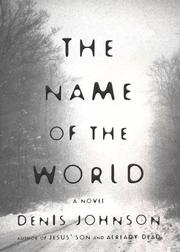
When fiction reading is going well for me, I translate the words into something that’s both fiction and non-. Take the novel The Name of the World by Denis Johnson, which I read recently for the first time. Here’s the first paragraph:

Since my early teens I’ve associated everything to do with college, the “academic life,” with certain images borne toward me, I suppose, from the TV screen, in particular from the films of the 1930s they used to broadcast relentlessly when I was a boy, and especially from a single scene: Fresh-faced young people come in from an autumn night to stand around the fireplace in the home of a beloved professor. I smell the bonfire smoke in their clothes and the professor’s aromatic pipe tobacco, and I feel the general unquestioned sweetness of youth, of autumn, of college—the sweetness of life. Not that I was ever in love with this scene, or even particularly drawn to it. It’s just that I concluded it existed somewhere. My own undergraduate career stretched over six or seven years, interrupted by bouts of work and transfers to a second and then a third institution, and I remember it all as a succession of requirements and endorsements. I didn’t attend the football games. I don’t remember coming across any bonfires. By several of my teachers I was impressed, even awed, and their influence shaped me as much as anything else along the way, but I never had a look inside any of their homes. All this by way of saying it came as a surprise, the gratitude with which I accepted an invitation to teach at a university.

I relate strongly to the narrator, who we learn later is named Michael Reed. The amount of emotional overlap between Michael’s and my life is scary. I too held similar images of academic life, for me perhaps set in the fifties and involving more letterman sweaters, but the same otherwise. Like the narrator, it took me six or seven years to finish college, and involved three transfers. I was also impressed by my teachers, and I also never imagined seeing the insides of their homes. This is exactly what I look for in a novel reading experience, a character who’s as much like me as possible, and telling his—our—story with a compelling, authoritative voice. Telling me, in short, about me.

But at least as important as my strong relationship to the narrator is the strong relationship I feel to the author. I read the above sentences, and I feel like I know the narrator’s shadow figure, Denis Johnson, very well. How can one write of this bucolic college tableau, “Not that I was ever in love with this scene, or even particularly drawn to it,” and not on some level feel the same way? I think of actors, who have to find something relatable in every character they play, even reprehensible ones. Can a writer fake this stuff? If he can’t, then what’s really the difference between Michael Reed and Denis Johnson?

And still there’s a third level in which I feel a deep connection to this work. As a writer myself, I feel a strong professional connection to the author for these perceived overlaps in our histories and psyches. Denis Johnson is a successful—even world-class—writer, and I hope that these emotional/biographical similarities mean that I somehow—despite all evidence to the contrary—am on some kind of path to a literary career. This guy is just like me, and he won the National Book Award! I can’t help but hope, despite my age, lack of comparable publishing success and absence of completed work as riveting as, say, Jesus’ Son, that I am somehow in the same game as Denis Johnson.

So The Name of the World hit me squarely because I relate to the narrator, and the writer, and because I want to succeed like the writer has succeeded. In other words, I’m about as perfect an audience for this novel as there is.

In all my exploration of writers and writing (B.A. in English, M.F.A. in Writing, 25 years of near constant reading and writing outside of class), I’ve rarely heard anyone mention this third, professional angle to readerly empathy. I suspect this is because, back when I was in school, writers still entertained the idea that most of their audience would come from actual readers and not other writers. There were of course “writers’ writers” back then, or those authors who were read almost exclusively by other writers—David Foster Wallace comes to mind. But I still think we were largely in the Saturday Evening Post romance of the reader/writer relationship, that is, educated people sitting down with books and magazines and being sucked in by written pieces. The author Gary Shteyngart gets credited for having said, “The number of people who read serious literature is now exactly equal to the number of people who write it.” Maybe an exaggeration, but probably the healthiest angle from which to come at a literary writing career in 2014.

Despite my deep interest in the writer of The Name of the World, I wouldn’t like the book as much if it were memoir. Imagine if the first sentence of the intro paragraph were “Hi, I’m Denis Johnson,” and “Denis Johnson” replaced “Michael Reed” throughout. I would still be interested in the book, and I’d probably read it and relate to it deeply at points. But I could never fully imagine myself into the narrator’s plight the way I can with the novel The Name of the World. In other words, the memoir The Name of the World would never quite be about me and Denis Johnson the way the novel is. The fiction tag allows Johnson, or any writer, to play both hands: he can utilize a fictional narrator, which allows the reader more leeway to see herself in the character, and he can titillate with suggestions of autobiography, which allows the reader to form empathy with the writer. Somehow these two readerly perspectives aren’t contradictory. The narrator of The Name of the World is both Michael Reed and Denis Johnson, and I’m fine with that.

READ MORE >

1 Comment
May 12th, 2014 / 10:00 am

In Theory, This Could Be Fun

Airport living from 5/14 thru 5/16 in celebration/mourning of the publication of my latest book, “The Fun We’ve Had.”

Any advice on keeping off of security’s radar? Anyone want a shout-out when I get really fucking bored? Anyone want to Skype while I’m leeching off the airport’s Wi-Fi?

Maybe I’ll just watch that Tom Hanks movie and do exactly what he did. Could be good.

Here’s the blog post I wrote about this, whatever this is:

In a big way, being in an airport is a lot like being lost at sea. So many places and possibilities to drift, but not if you don’t already know where it is that you’re going.

I don’t know where I’m going. That’s why I’m not going anywhere.
I’ll be living in an airport for 48hrs.

Beginning 10AM on Wednesday May 14th through Friday May 16th around 10AM: Going nowhere and probably getting into some shit. There’s a good chance I will no longer be human by the end of it. There’s a pretty damn good chance that I’ve never been human. Not to worry, I’ll be online and active during the entire thing.

Odds are you’ll hear from me, be it a tweet, a post on Facebook, or a photo/video on Instagram. I’ll be calling out to everyone while I’m stranded in a state of flux. I’ll also have one of my best writer friends around, Kyle Muntz, hanging around, surviving this ridiculousness with me.

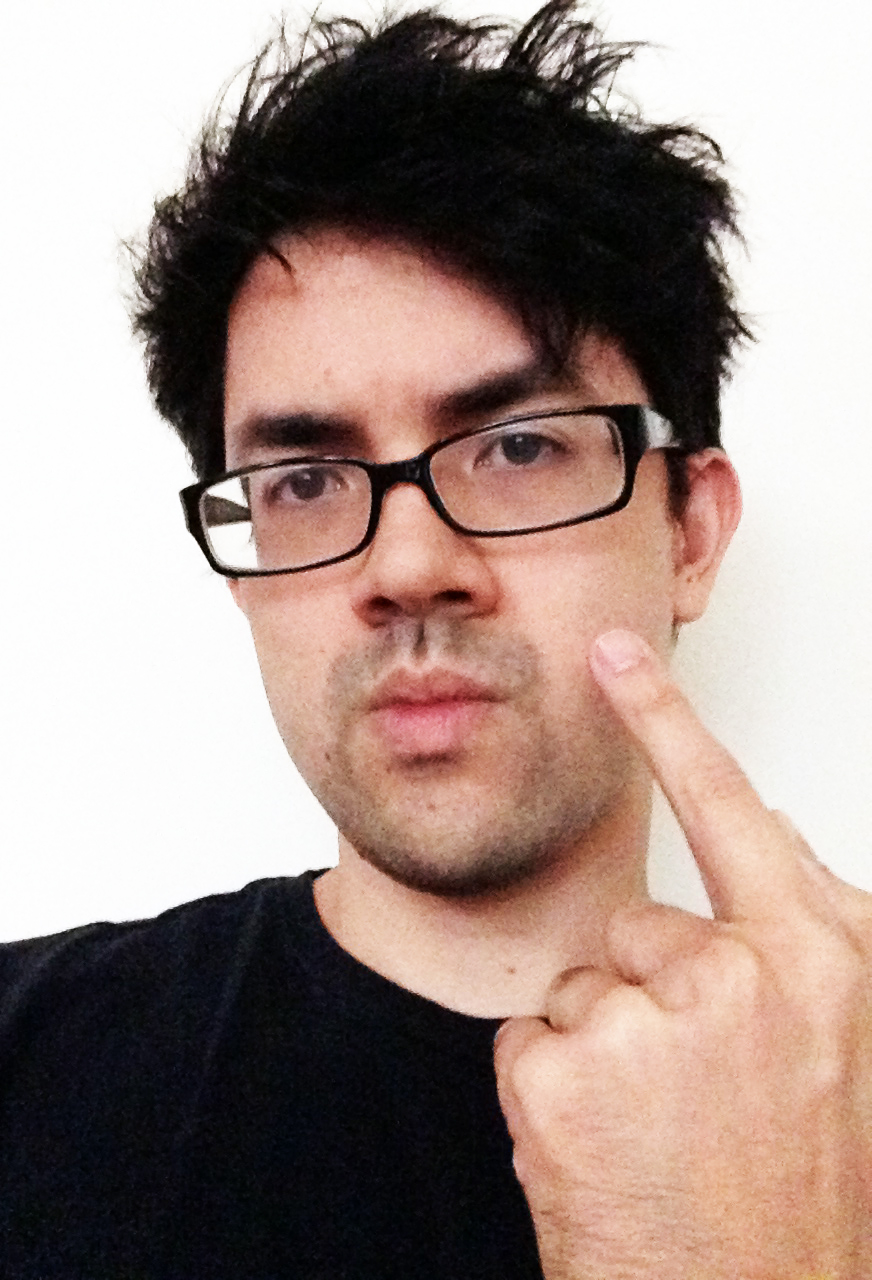
 Yes I’m serious. Look how serious I am:

Seriously

Will it be fun? I hope so. If not, I’ll be at the airport bar.

\m/ \m/

Random / 7 Comments
May 12th, 2014 / 9:30 am

Sunday Service

Michael Credico

Tom

Tom woke up thinking it was the apocalypse.

Nobody worried until Tom became indifferent.

“Far as you know, we’re done for, and you couldn’t care less?” his brother said.

“Yes,” Tom said.

His brother drove him to the hospital.

The receptionist gave him a form.

“Where should I sit?” Tom said.

The receptionist pointed to a row of chairs in the waiting room.

Tom said, “I thought they’d be bigger.”

“There’s a bed in the examination room.”

The receptionist was also a nurse. A blouse on top, scrubs on the bottom. You only saw them when she stood up, which she did to show Tom the row of chairs.

Tom filled out the form with two words: It’s over.

The doctor saw him half an hour later and said, “What do you mean?”

Tom said the world is ending.

The doctor was checking Tom’s reflexes. He said, “How?”

Tom said, “You’ve never watched television?”

The doctor said, “Do you watch a lot of television?”

“I dreamed of a television last night. I turned it off. I didn’t want to spend my last day like that.”

The doctor called the receptionist/nurse into the room. He said to her, “What if he’s right?”

“I don’t want to spend my last day like this,” she said. She tore off her blouse.

Tom didn’t notice before, but her left arm was a prosthetic. She tore that off too. It landed in the sink. She reminded Tom of a plastic soldier. When they broke, he’d melt them with a magnifying glass and reshape them into something else.

The topless/one-armed nurse/receptionist sat on the bed with Tom.

“Can you tell us?” she said.

Tom said, “All I have is a lighter.”

He flicked it and her scrubs burst into flames.

This was not at all what Tom thought it’d be.

The doctor began to douse the burning/topless/one-armed nurse/receptionist with water, still asking, “How?”

Bio: Michael Credico’s fiction has appeared or is forthcoming in MonkeyBicycle, Necessary Fiction, TheNewer York, Word Riot, and others. He lives in Cleveland, Ohio, where he edits Whiskey Island.