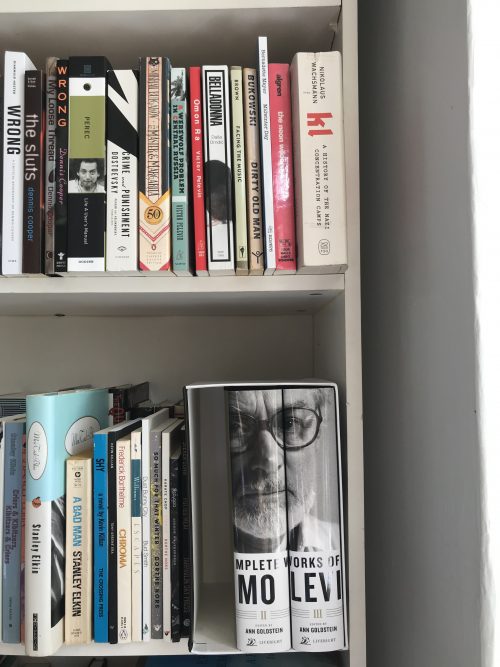
I bought The Complete Works of Primo Levi with unemployment money. It comes in a box and when the spines of the three volumes are put together they form the face of Primo Levi. When I am in my living room I can see Primo Levi and he watches me. We make eye contact. But I took the first volume out of the box and now he is missing a quarter of his face.
* * *
I am reading Levi’s first book, If This Is a Man, a memoir of his experience as an Italian Jew in Auschwitz. When the book was published in America it was given the title Survival in Auschwitz, a title almost as bad as Auschwitz for Dummies.
Put Auschwitz in the title or they won’t know it’s about Auschwitz, an editor must have said.
* * *
My great-bubby, Ethel Belgratsky, fled pogroms in what is now Ukraine long before the Holocaust and she lived in Montreal during the Second World War. But I don’t know what happened to the cousins and other relatives who never left. My Uncle’s wife’s mother survived the camps and fell in love with a Russian soldier. My grandfather—I call him Papa Howard—doesn’t know where our Novaks originate but the legend is that we are Lithuanian Jews. Litvaks. None of this is concrete to me. All of these people I never met swirl around in my head.
* * *
I like this book a lot. It is not a long book. I am reading it slowly because the sentences are rich and unique, simultaneously simple and complex, and the subject matter isn’t something I find myself able to breeze through. Every chapter is about life and death and pain and humiliation and hunger and thirst and hope and hopelessness and language and fear and the random stupidity of evil and innocence and cunning and chance and disease and excrement and chemistry and clothing and bowls and spoons and soup and bread and humor and fatigue and judgement and memory and war and almost no peace.
* * *
I read some of If This Is a Man on the blue couch in the living room in the morning. My back hurts. I don’t like our bed. Sometimes I sleep on this couch when I am sick of the way our bed is treating my back. It is winter and Primo Levi is in a crammed boxcar headed to Auschwitz. The men, women, children, and infants suffer “from thirst and cold.” Finally, after a long journey from Italy to Poland, the train stops. Primo and the woman who has been pressed against him for the entire journey, an acquaintance of his, say to each other “things that are not said among the living.” They say “farewell and it [i]s short; everybody s[ays] farewell to life through his neighbor.” Then the train car doors open and the men and women and children are separated by SS guards. The able-bodied men go one way and as for the women and children and old people, “the night swallow[s] them up, purely and simply.” The book is heavy in my hands. Each volume is a hardcover and Volume I is 747 pages long. IfThis Is a Man is the first book in Volume I and it ends on page 165. I am on page 16 and my eyes are wet after reading about a three-year-old named Emilia who had to be killed because she was a Jewish three-year-old. My hands and arms have to work to keep the book from falling onto my face.
READ MORE >





 In the book, the words were in sentences full of glow and ache and the proud civility of the self-fucked, the calm leak of “Excuse me, there’s a knife in my eye.” And also of course the weeping and calling bartenders your mother. They were words about clouds that looked like brains, but they were also words like “help” and “stay” and “save.” Those little words forever hitchhiking back to church and never making it all the way. Paragraphs would interrupt themselves to turn to you. I was 17 and hadn’t read Levinas or Buber, and yet here was the “you” that knew the face on the other end was always dark. Little words like “search” and “name.” Paragraphs that interrupted their description of a shriek to tell you they have gone looking everywhere. For the shriek, they mean, but mostly it’s the gone, and the looking, and the everywhere.