Reviews

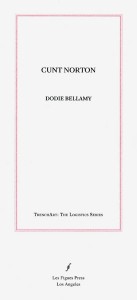
Cunt Norton by Dodie Bellamy

cuntnorton_frontweb_0Cunt Norton
by Dodie Bellamy
Les Figues Press, November 2013
75 pages / $15  Buy from Les Figues Press or SPD


In Cunt Norton, Bellamy slices the canonical texts, lifts the raw skin, and slides all kinds of exciting things into the wound. Then she sews it back up. The result is a bulging, infested boil of sex and gender. The result is dirty love poems secreting out the orifices of our favorite fathers. (And one mother: Dickinson.)

Playing off of William S. Burroughs’ “cut-up” technique, Bellamy published Cunt Ups in 2001. Now she’s back at it, “cu(n)ting” up the 1975 Norton Anthology of Poetry. She selected thirty-three poets from the anthology and has re-imagined their texts: cutting and interspersing their words with hypersexual language. Poets ranging from Shakespeare to Ashberry still sound remarkably like themselves. They are recognizable—only sloppy with desire. Dripping wet.

The multi-gendered speakers in Cunt Norton end up sounding at turns psychotic, absurd, and boring—which comes pretty close to the actuality of sexual encounters and the language we use for desire. When the speaker in “Cunt Auden” says, “You be a good girl—I’ll take care of you—lay here in my hands with their many fingers. I’ve never ever given anybody help who didn’t come” (57), I want to barf at the sad, true, cliché of it. I feel the same with “Cunt Yeats,” which begins: “Gloom is in my mind, and I have to fuck you so bad. Good girl. Good girl” (40). “Cunt Blake” finishes with a hearty, “I poke out and in thee in so many places, the Air shreds to Rags and the Heavens tear” (21) and “Cunt Tennyson” promises to “fuck thy portal until mouths, foreheads, eyelids lose all boundaries” (35), both of which are equally hilarious and scary. I am reminded of all my worst sexual experiences.

Other pieces are full of rollicking, gender-bending, free-for-alls. Take, for example, “Cunt Frost:” “My clit stands still and dances—it looks huge, the outer lips filling the abyss’ void with emptiness. It cries out for you. […] My cock is normal size, ready to throw back without regret into your cunt or your large intestine” (43). The Great Men from the Norton Anthology are marionettes in Bellamy’s hands. Their reputations are at her disposal: their genitalia grow and morph, their gigantic desires never satisfied.

But Bellamy’s book is as much a political act as it is a book of poetry.

Let me offer an example why. Recently, after I participated in a reading, a fellow (male) poet asked me why I write about the same thing (sex) all the time. And why do I use such vulgar (cock, cunt, etc.) language? He suggested that I would get more publications if I varied my subject matter and cleaned up my language a bit.

Dodie Bellamy’s Cunt Norton exists as an answer to these kinds of questions. What I mean is: Dodie Bellamy is a woman who writes about sex. Who writes with verve and risk and imagination. Who isn’t afraid of language, or of dead white men, or the reverence we are supposed to have for them. Dodie Bellamy will not be silenced or ashamed. When Ariana Reines writes in the book’s introduction that this “could be the most joyful book on Earth” and it “made me feel so good I laughed so hard I cried,” what she may be articulating is how powerful it feels to witness a woman writing exactly how she wants to write, refusing to be silenced (by the canon, the patriarchy, any other poet’s aesthetic or ethical impulse).

READ MORE >

1 Comment
October 14th, 2013 / 11:05 am

Reviews

The Childhood of Jesus

9780670014651_p0_v1_s260x420The Childhood of Jesus
by J. M. Coetzee
Viking, Sept 2013
288 pages / $26.95  Buy from Amazon


As someone who has recently come to Australia, I find the reviews of Coetzee’s latest novel astounding. His early novels Life and Times of Michael K and Waiting for the Barbarians had readers and reviewers inferring the novels’ South African racial and historical specificities, with neither being identified in the books. Reviewers of The Childhood of Jesus, however, have mainly commented on the novels’ insular, literary and ageographical nature. Some reviewers have even gone so far as to say the novel is set in “an entirely Coetzeean universe” or a ‘Novel-land.’ Strangely, there has been an appalling lack of recognition of the book’s Australian context.

Reviews of most of Coetzee’s novels since he emigrated from South Africa to Australia have taken a similar tack. Many reviewers and critics have viewed his departure from Africa as being a departure from his usual themes of postcolonialism, nation and race. Coetzee’s speech given upon receiving citizenship seems to contradict this, with him saying very publically that in “becoming a citizen one undertakes certain duties and responsibilities.”

The Childhood of Jesus tells the story of middle-aged man, Simón, and young boy, David, who arrive by boat as immigrants in a Spanish-speaking country. Somehow in his previous life David lost his mother and on the journey to their new life Simòn vowed to help the child find her. Helped by the usual Coetzeean/Kafkan bureaucratic nightmare, the pair find accommodation, work and friends. In this new world, everyone seems to be an immigrant arriving by boat and none of them speak about their old lives.

Eventually Simòn finds a mother of sorts, Inés, for David and entrusts the boy to her care. Simòn continues to be heavily involved in the boy’s life and acts as a kind of teacher to him. David however is not a willing student and has entirely novel ideas on mathematics and language, getting him in trouble with school and eventually the state.

Reading Childhood during an election period shortly after I arrived in Australia may have made me more keenly aware of the novel’s Australianess. I appear to be almost alone in this thought though. After trawling through pages of reviews, I was staggered at the lack of writers connecting the novel to Australia’s current political and sociological position. A few reviews make the connection briefly but swiftly move onto discuss Coetzee’s high philosophical ideas.

One of the biggest areas of debate in past years in Australian politics has been the so-called “boat people”. Numbers of refugees arriving in Australian illegally by boat have dramatically risen in recent years – although the numbers are not big enough to warrant the size of the debate. Many of these are ethnic Hazaras fleeing Afghanistan (a country that Australia has a military presence in).

“Family reunions” is another hot topic in Australian politics. This is where refugees who are already within Australia apply to have their family members who have not yet escaped their country join them in Australia.

READ MORE >

Comments Off on The Childhood of Jesus
October 14th, 2013 / 11:00 am

TWOCLOSEWORDS: HAUNTING / HUNTING

37445665_4ae3692051_z

(A scene from Les Maîtres Fous (The Mad Masters), a film by Jean Rouch)

Haunting –

My left eye is fucked. It isn’t the first time. I’ve mentioned its swollen episodes everywhere: in poems, on the phone.

Because I think it’s hysterical. Because I really can’t get over it.

LOLOLOLOL. A POET. WITH A SENSITIVE. EYEBALL. FUCK ALL THAT.

Lately, there are tiny, irritated dots that have been piling up in the corner. My roommate gives me clay and DMSO, which is HORSE LINIMENT. She dabs it on for me. The eye’s anger ebbs and flows.

I like that my own body keeps haunting me from this particular room, always from this left eye, trying to get me to deal with or acknowledge some part / stress deposit of myself that I’ve neglected / buried. Your own body interrupts you. It unexpectedly cuts you off. I feel more than slightly disembodied when I look at it in the mirror, when I touch it. Ghosts are red.

READ MORE >

Craft Notes & Random / 3 Comments
October 13th, 2013 / 2:38 pm

Sunday Service

(Canadian) Sunday Service: Laura Broadbent poem

NOTE: Canadian poetry! For no particular reason, I am taking over Melissa Broder’s column for the month of the October to spotlight poems by contemporary Canadian writers. Today’s poet is Laura Broadbent, whose (sharp, funny, underated) debut collection, Oh There You I Can’t See You Is It Raining?, was published late last year by Invisible Publishing.

Oh There You Are I Can’t See You Is It Raining?

1.
Supple with incoherence, I have not
learned how to people myself.
Lose any hope. Above all, lose any hope.

2.
I’ve never enjoyed a party in my life.
The meaning of this hits a little too deep.
The only women for me live a tonal complexity.

3.
The biggest fact about anyone is their mother.
I know this is getting a little complicated.

4.
Art school students love art school students.
There is something unutterably terrible
About art school students.

5.
He likes it when my nails are short and clean.
Since it’s love there’s nothing easy about it
so I threw my wine glass at him.
Old wounds and their flatulence.

6.
No one told me it was problematic to be a woman
until I started getting treated like one.
I Googled ‘Why are all Aquarius men jerks?’
I wasn’t the first.

7.
When I try to describe you
my mouth gets an E for Effort.
I invite you for a dip and you think
its an invitation to drowning.
Find some bearings
then ostensibly learn to keep them.

8.
Obligatory fun is ostensibly fun.
The project of the intellectuals.
Don’t open an intellectual
unless you want to be killed.

9.
To lose those I love most.
What other lessons are there –
how to make a perfect gazpacho?
I still believe in forces.

10.
Anger is one of my charming knacks.
Also panic for no discernable reason.
I remember things with my whole body.
Men like it when I ostensibly behave.

11.
Supple with incoherence
Art school students are
terrible
at making the perfect
gazpacho.

12.
Obligatory fun gets an E
for Effort. When you’ve lost
those you love most,
your only hope is in
charming knacks.

13.
The biggest fact is a little complicated.
So throw your wine glass at it
then clean your nails and Google
‘ostensible women.’

14.
I invited you for a dip
then you treat me like a woman.
Google: ‘old wounds
AND tonal complexity.’

15.
Getting killed: obligatory fun.
No need to get all emotional
and intellectual about it.

16.
The project of the intellectuals:
the terrible fact of
women and flatulence.

17.
Everyone’s mother is problematic
trying to do something about
feeling unloved.

18.
Art school students’ projects are parties.
Be on guard for the projects of art students

19.
Men like when my whole body
is ostensible.

20.
Remembering things
is an invitation to drowning.

Laura Broadbent was raised in Stratford, Ontario and has resided in Montreal since 2005. Her first book of poetry Oh There You Are I Can’t See You Is It Raining? (Invisible Publishing, 2012) won the 2012 Robert Kroetsch Award for Innovative Poetry.

poetry-foundation-4

in a recent Open Letter to the Poetry Foundation the poet Sandra Simonds states:

Last year the Poetry Foundation’s income was over seven million dollars and the foundation’s total assets are well above 150 million dollars. I was disappointed to learn that the Poetry Foundation gives only around $7,500 annually to poets in need.

A petition to The Poetry Foundation that you can sign if you want has been set up at Change.org

(It currently has 177 signatures)


When procrastinating, what do you do? I need pointers.

Writing That Makes You Feel Like You’re Being Groomed

poodle grooming

***

When John Ebersole reads work he terms “Grocery Store Poetry” (GSP – which includes also, for John, Linda Pastan, Billy Collins and, most immediately, present-day Thomas Lux) he says “I also get the sick feeling like I’m being groomed.” This quote comes from a little Q and A I recently did with John because when I read his review of the new Thomas Lux book (you can read it here on HTMLGIANT) I was struck by (hello, Paul Cunningham) how upset, how disturbed John seemed to be. And this reminded me of how I feel when I read certain people. Disturbed. And sometimes, for sure also, like I’m being groomed. (shiver, shiver).

This is particularly the case when I read Whitman and experience not just the great POETRY but also the feeling of a clammy arm slipping around me over and over in a cheap movie theater, of a pale tongue in my ear, of a breathy voice trying to massage my entire being into submission. Nice, easy and compliant. And that’s creepy, yeah. And creepy, also, to think (and know) that while I’m reading Whitman and experiencing the tremendous virtuosity of imagination and spirit that a part of him’s masturbating in the row behind me.

But, you know what, it’s ok, because it’s Whitman and I accept the fact that he’s grooming me. That he wants and needs me to surrender to his voice, his work, his divine right (yeah, he thought he was a new Jesus for America). But, for Christ’s Sake, we’re talking now about writing like late-career Thomas Lux!

***

Rauan: I believe you’re suggesting that “Grocery Store Poetry” written by Lux, Pastan, Collins, etc, isn’t attractive and vital because even though the world’s always been in turmoil “the way we apprehend that turmoil has changed and changed dramatically.” And you’re suggesting then I think that we need more a riskier, stronger sort of poetry (a poetry of derangement?) because “globalization and the relentless whiplashes of information rearrange us.” Your thoughts on this please?

wittgenstein

“Wttgenstein once wrote” — don’t worry, we’re just fucking kidding

John: Wittgenstein once wrote – I’m fucking kidding. I’m less READ MORE >

Behind the Scenes & Mean & Random / Comments Off on Writing That Makes You Feel Like You’re Being Groomed
October 12th, 2013 / 1:12 pm

Flood Relief

Flood_full_web

There was a flood in Colorado and NewLights Press, which specializes in high-quality handmade books, is giving all the money they make this weekend to help fix things. Their books are beautiful. You should check it out.

Presses / 1 Comment
October 11th, 2013 / 1:36 pm

Reviews

Hearing Hearing: A Review of Jacob Kirkegaard’s Labyrinthitis (2008)

“We do not yet know what a sonic body can do.” -Steve Goodman

In a collection of notes entitled The 1914 Box, Marcel Duchamp said that “one can look at seeing; one can’t hear hearing.” (Bloch 1974) Working within a lineage that includes Cage, Schaeffer Lucier, and other artists, Jacob Kirkegaard’s 2008 sound installation Labyrinthitis articulates a response to Duchamp’s claim, demonstrating through the phenomenon of distortion product otoacoustic emissions (DPOAE) that one can in fact ‘hear hearing.’ Further, in articulating the space of human hearing, and ‘playing’ the human ear “just like an acoustic instrument,” (Kirkegaard 2008) Labyrinthitis questions the canonical notion of hearing as a passive process, a “one-way route of transduction,” (Kahn 2008) and grounds the semioticity of listening as distinguished from hearing in a materialist approach which eschews representation, using sound not as symbol but as intervention (Lindblom 2010). In this sense the work is firmly grounded in the tradition of site-specific sound art, creating a discourse space in which technology and the body, artist and audience, exist not on opposite sides of dichotomies but on a continuum.

The contents of Duchamp’s 1914 box (photo courtesy of: http://www.tate.org.uk).

`What did Duchamp mean by “looking at seeing?” He meant to describe “the particular interpretative effect which accompanies optical illusions.” (Betancourt 2003) For example, in the Rotoreliefs, the contrast between a static disc and a moving disc creates a visual oscillation, allowing us to ‘look’ at the mechanism of seeing and understand a number of constraints: that the illusion is only possible for us when the relief is in motion; and that when the relief is in motion, we cannot distinguish the two discs— we can only see them as one (ibid.).With the knowledge that there are in fact two discs but that, when the oscillation occurs, we apprehend them as one, we can infer that the configurational relationship between the two activated discs causes the limits of our perception to ‘synthesize’ a new image entirely from our perceptual processes: in this way we can ‘look at seeing.’ (Ehrenzweig, 24)

Then we can begin to interpret the phenomenon, as Betancourt states. This also allows for a new, non-teleological artistic-perceptual structure (ibid.), and the discourse domain which this kind of art articulates is not predicated on phenomena as representations but on an exploration of the material aspects of the phenomena themselves, the ability to observe the sensory mediation of experience, and its limits. Though the groundwork had been laid by Schaeffer, Cage, and Lucier, as well as through Dianne Deutsch‘s discovery of the octave illusion in 1973, and Maryanne Amacher‘s work with otoacoustic emissions in 1999, until Kirkegaard’s Labyrinthitis, there had arguably been no sound-oriented process explicitly analogous to optical illusions which would cause one to perceive a mismatch between stimulus and receptor activity in the human ear, and there had been not been as cogent a response to the passive connotation of hearing which is so pervasive in the historical musical narrative.

In 1978, physicist David Kemp demonstrated for the first time in a scientific context the phenomenon of otoacoustic emissions (OAEs) (Kemp 1978). These are audible sounds which the inner ear itself generates, and which can either be spontaneous (SOAE) or evoked by pure tones (EOAE). Commissioned by the Medical Museion in Copenhagen, Kirkegaard’s Labyrinthitis is composed on the basis of the latter, particularly distortion product emissions (DPOAEs). In fact, similar findings were reported in the 18th century by Guiseppe Tartini, who while investigating violin double stops discovered that two simultaneously-played tones may cause a listener to perceive a third tone (Tartini 1754). Indeed, it should be noted that OAE’s are anomalous only insofar as they are audible: the the very process of hearing involves the vibration of the cochlea’s hairs when two tones enter the ear, which causes electro-chemical responses to the vibrations; in certain cases this vibration causes “movement of the connected basilar membranes,” which in turn causes the ear to emit sounds as a byproduct of hearing (Fischer 2008). Thus OAE’s could be considered ‘amplified’ instances of a generalized property of the human ear.

(Photo courtesy of: http://fonik.dk/works/labyrinthitis.html)

Looking to use this phenomenon as a compositional impetus, Kirkegaard inserted tiny speakers and a microphone into his left ear. The input is a pair of primary frequencies in “a ratio of 1 – 1.2,” (Kirkegaard 2007) the interaction of which causes a DPOAE in Kirkegaard’s inner ear. The microphone picks up this and other resultant DPOAEs and amplifies them enormously, outputting them to the audience as they arise. The audience will have its own DPOAE’s when confronted with Kirkegaard’s, so much so that, at a loud volume, the piece seems to turn one’s ears into a bright resonant magnet, sound buzzing ticklishly out of it, at least in my listening experience. The receivers of sound in fact become producers of sound in the act of receiving, and this creates a potentially-endless feedback loop (which actually renders compositional decisions largely arbitrary). Therefore, the piece is a musical analog to the concept of Duchamp’s Rotoreliefs, since it builds its discourse not from sound as representation but from the actual sound phenomena, and since the configuration of the pure tones, like the static and moving disc, causes a mismatch between input and receptor activity, creating a space in which the resultant phenomenon, DPOAE’s, can be explored and encoded with meaning. It is a rebuttal to Duchamp’s claim that one can’t hear hearing.

READ MORE >

1 Comment
October 11th, 2013 / 11:05 am