
STARK WEEK INTERLUDE: SLampson at the Beast Forest
This is what happens when a poet quotes his poetry to a weird worm-looking thing in Second Life, a 3D world that announced a ban on in-world gambling on July 28, 2007, in fear that new regulations on Internet gambling would affect the privately held American Internet company if it was permitted to continue.
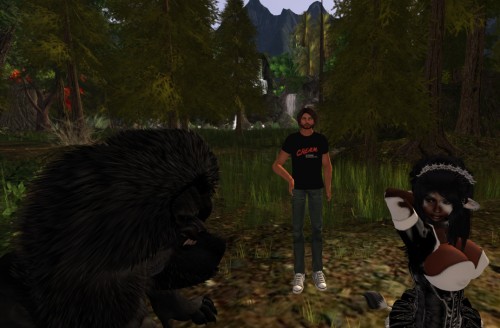
[21:11] Slampson Slarkweather: this forest is unusually horny.
[21:13] Namadisi: it is a romantic forest on the sky hahahhaha
[21:13] Namadisi: :)
[21:15] Slampson Slarkweather: They sky has no clouds here. Just a ridiculous blue.
[21:16] Namadisi: maybe is your viewer?
[21:16] Namadisi: i see clothes
[21:19] Namadisi: lol
[21:19] Namadisi: clouds
[21:20] Namadisi: hahahahhhahaa
[21:22] Namadisi: and clothes or course
[21:23] Slampson Slarkweather: Anyone who dances with their shirt on is dead to me.
[21:23] Namadisi: hahahahahahahahaa
[21:24] Namadisi: we ae near the lake who wear shirt near a lake???
[21:26] Slampson Slarkweather: Fracking laws and loopholes taught us water is winning.
[21:27] Namadisi: hhahahahaha the water does look nice
[21:27] Namadisi: you should go take a dip
[20:28] Slampson Slarkweather: You should really come see what it’s like down here, to be me.
[20:30] Namadisi: where r you?
[20:33] Namadisi: hahahhaa now i know what you mean hahahahhaa
[21:35] Slampson Slarkweather: I want to go home, find you have been living beneath my bed, take off all our clothes, lie back and talk and talk until it’s ruined the stars.
[21:38] Namadisi: wow
[21:38] Namadisi: nice words poet?
[21:38] Slampson Slarkweather: i’m not a poet i just crush a lot.
[21:39] Namadisi: hahhaha
[21:39] Namadisi: you fo that well
[21:40] Slampson Slarkweather: My friend thinks poetry has nothing to do with words.
[21:42] Namadisi: well thats silly poetry has eferything to do with words
[21:02] Namadisi: :=))
[21:42] Slampson Slarkweather: Poetry is exactly like sexual harassment. Don’t ask.
[21:43] Namadisi: no i think i understand =P
[21:44] Slampson Slarkweather: Your exercises in empathy are encouraging, but is it really possible for two people to ever understand each other?
[21:45] Namadisi: hmmmmm good question
[21:45] Namadisi: i think so
[21:46] Namadisi: if you get 2 kno someone well enough and spend alott of time listening to each other then yea
[21:47] Namadisi: thats true love =D
[21:49] Slampson Slarkweather: I have love like a headache.
[21:49] Slampson Slarkweather: Sure you can cut a hole in a sheet but good luck trying to fuck a ghost.
[21:51] Namadisi: O-o what do u mean
[21:51] Slampson Slarkweather: Hello plasma. It’s me, fellow fake state of matter.
[21:54] Namadisi: is this a joke or somethin’
[21:55] Slampson Slarkweather: the secret to life is being tan.
[21:56] Slampson Slarkweather: Give me your wallet.
[21:56] Slampson Slarkweather: Did you think this poem was going to end by itself?
[Note: This dumb thing was inspired by this broadside from Rye House Press.]
Marie Calloway’s google docs pieces

I think I really like the pieces Marie Calloway has been publishing via Google docs & sharing as links on Facebook & Tumblr post-“Adrien Brody” & “Jeremy Lin.” They are surprising and create a feeling that seems like a secret private virus or a window. There are people in the world.
Insufferable by Marie Calloway
Cybersex by Marie Calloway
Criticism by Marie Calloway
Men by Marie Calloway
Seems significantly more “sincere” in an actually vibrant way than a lot of the other things people have been pointing at as “sincere” lately. Not that I think sincerity is important, but I’m confused as to how people can point to repurposed internet-speak tumblr-timez poise as not of an extremely orchestrated intent. It’s not very interesting to watch the same buttons being pressed over and over. I like mutation. I wish there was less obvious fear.
If nothing else, these new works by Marie Calloway seem singularly her, and rapidly feedbacking at themselves in a way that wakes something else up, which is refreshing.

What’s so funny
What makes you laugh? There was a book reviewed recently in the NYTimes that dealt with the science of revulsion; do you think there is a science to what ignites our different senses of humor? Do you think it could be chromosomal or is it strictly learned? Does anyone else feel sad or depressed when they watch Seinfeld? When Kramer enters a room and everyone laughs, doesn’t it just make you want to cry? Why don’t you find the same things funny as many of your friends? When a fat kid falls down and someone gets it on video and puts it on youtube, is that funny to you? How much of what we deem funny is enmeshed in some idea of power? Of (first) relief at not being the one laughed at, and then a growing delight in the privilege? Are we so lonely that when Kramer walks into the room we feel less alone and so we sigh with relief, the sigh which can be a kind of laughter? Or is Kramer walking into a room somehow “legitimately” (scientifically?) funny? READ MORE >
Coco on Writing

“When I was around [Ice-T] for a couple weeks, I gathered all the facts of what he liked and what he didn’t like, and I just shape-shifted into that woman for him.”
“If you saw my boobs before I got them done, they were actually a nice size; nice and squishy, waterly [sic], flip em’ around, you know…”
“My hips were always a little bit bigger than the top half of me and I wanted to even it out.”
“It’s too time consuming, and honestly, people with lives don’t really have the time to make comments at all. I don’t even have the time to go on the Internet anymore. Who has the time to actually log in, put your email address in, put if you’re female or male and all of that good stuff, and then make a comment…” READ MORE >
Not A-Z, but I-Me

There’s a scene in that movie High Fidelity (based on the Nick Hornby book, I guess, which I didn’t read) where John Cusack’s character reveals to Dick, his record store employee (played quite brilliantly by Todd Louiso), that he (Cusack) was in the midst of reorganizing his record collection–in autobiographical order.
I’ve always loved that idea. READ MORE >
Youtube teaches me something about writing.
Above is video of the reaction of José Saramago to the filmed version of his book Blindness. READ MORE >
This again, not this again
 I wasn’t going to write this, feeling like the last thing anybody needs is another post explaining or defending or extolling paper, but then two events became bridged in my mind and I felt like I would be restless until I wrote them, about that bridge, so there you have a little apologia for what follows, which is that I moved some months ago to a new house, and recently found myself sitting on the floor late at night amidst boxes filled with folders and smaller boxes, and several folders were marked MISC and contained all kinds of paper, critical essays that I wrote during college and grad school about Emily Dickinson and Auden and post-structuralism and William Blake, and pages from the first novel I wrote, and pages from the first “novel” I wrote, and notebooks filled with other writings, and long letters never sent, and then I opened a box within a box and it was filled with floppy discs, each one labeled with the year and some vague tags, like “teaching stuff” and “post-mod essays” and “stories/summer” and “Needle,” and I just held those floppies like they were quaint artifacts from my Victorian childhood, realizing that I had no means of accessing their contents, and then stacking them neatly back into their smaller and then larger box, and returning to the piles of paper feeling a kind of profound agitation with regard to permanence or the myth of permanence, and remembering standing outside of the office where I worked just a couple blocks from the World Trade Center READ MORE >
Ken Baumann—
“Whose arm is this?” She said, “That’s my mother’s arm.” Again, typical, right? And I said, “Well, if that’s your mother’s arm, where’s your mother?” And she looks around, completely perplexed, and she said, “Well, she’s hiding under the table.”
– Errol Morris on anosognosia and much much more, in five parts. Starts here.