
Check out this My Pet Serial Killer (by Michael Seidlinger) Video Review by Angela Xu and Peter Tieryas Liu. Starring Hannah Lee. Read Peter Tieryas Liu review on HTMLGIANT here.
Dysfunction
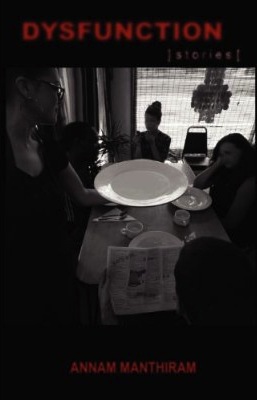 Dysfunction
by Annam Manthiram
Aqueous Press, December 2012
170 pages / $14 Buy from Amazon or Aqueous Press
The dysfunctional nature of many of the characters that populate Annam Manthiram’s Dysfunction only serve to highlight their strange humanity. Throughout, “Variations on a Blossoming Marriage,” we are treated to an alphabetical catalog of failed relationships. The description for Calla Lily is poignantly emblematic of a plight the characters share: “He liked white— white everything. White sheets, white toothpaste, even white curry. I didn’t know how to make white curry. Everything I touched turned brown.” The clash of tactile expectation versus the moment of actual contact is the intersection that the stories hinge on and that fulcrum becomes more pronounced with the cultural context denoted by brown.
In “Asha Ma,” we are taken through the life of a young Indian woman. From the moment she is born, there is an invisible gauge against which her life is measured. When she fails to match the barometer her mother hoped for during a ritual performed for her first birthday, she is deemed “inauspicious” and “a sacrilege.” The irony is that, of course, a simple baby game intended for playful festivities takes on religious connotations that would haunt her life. In high school, she is often mistaken for another Indian student named Cynthia. When Cynthia takes time off from school due to chicken pox, Asha masquerades as Cynthia, and in a sad commentary on racial stereotypes, the other students can’t tell the difference. No expected fallout happens upon Cynthia’s return, who simply refers Asha to the principal and he in turn to a therapist. Neither of them can help her find what she wasn’t able to track down for her birthday ritual; her identity, mainly because the given categories didn’t fit. A disconnected relationship happens with her co-worker, Joe, whom she both attracts and repels. It ends when she makes out with a stranger at a party Joe invited her to (more specifically, the stranger licks her clavicle). Again, there is no blowout, no jealous outrage by Joe. Instead, he falls for another woman at the office and moves on. The story reaches its denouement with a sordid revelation of a past affair from her parents that causes Asha to come to terms with her absent self. The ending consists of self-discovery in defying self-discovery. Pat epiphanies about ‘place in the world’ are replaced by acceptance of the void of simple being and the climax defuses itself similar to the other encounters in the story.
2 Comments
June 3rd, 2013 / 11:00 am
June 3rd, 2013 / 11:00 am
Memory of the Prose Machine by Sandra Doller
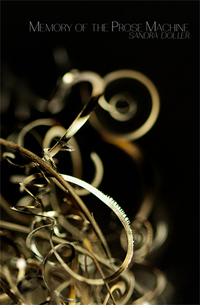 Memory of the Prose Machine
by Sandra Doller
CutBank Books, Feb 2013
41 pages / $10 Buy from CutBank
Two days before I arrived home to the package that held Prose Machine, I sat in a restaurant in Moab, Utah, arguing with my girlfriend about poststructuralist theory. The endless bit about relevance. Do we really need to know that much about the gap between words and reality? About the absence of a referent for language? We’re eating hamburgers in a café here. We’re on a road trip in Utah. We’re speaking. We’re talking. Hello.
Emily wondered why the academics didn’t quit if the very form of their own work (language) went against the claims they made. As I saw it, admitting that language doesn’t have a one-to-one correspondence with what we’ve always hoped it does doesn’t make communication impossible; it just complicates it. Maybe even frees it.
Sandra Doller is, like me, one of the hopeful. She understands that a splatter of paint on the canvas is going to look like a penis to me and a popsicle to someone else. But that the important thing, I think, is the communication: there’s someone on the other end.
***
The central conflict of Memory of the Prose Machine, as of more than a couple other rad small press prose-poetry type books I’ve read recently, is meaning. That is, what does it mean when she says, in her opening lines:
“They say I have no theme. I get sick of the whiting. Cisk of it I get here by the water by the wawa. Say wasa. Sat it with me. Say now here now look here. Well would you looky there a duck.”
Sandra Doller knows, because she’s already been told. She “has no theme,” her words are a bunch of words, that’s all, you can’t follow them because there’s nothing to follow. That’s just how the book is. And it’s not uncommon, I think, to have this kind of indeterminate non-referential Rorschach Test type of approach in cutting edge poetic writing these days. Language without a clear function. Phrases not connected in obvious ways. Words as the field of battle, rather than the images they evoke.
1 Comment
June 3rd, 2013 / 11:00 am
June 3rd, 2013 / 11:00 am
Michael J Seidlinger’s SUMMER READS
SUMMER READS: Starting today and over the course of the next couple weeks, I’ll be posting some summer reading recommendations by various writers.
I asked the writers to recommend a few books for summer reading, or to talk about some books they’re particularly looking forward to delving into this summer.
First up, some great picks from Michael J Seidlinger:
***
 The First Four Books of Sampson Starkweather by Sampson Starkweather (Birds LLC, 2013)
I only recently discovered this guy’s poetry and I am truly kicking myself for it. His poems weave together humor and pop culture references. The book is 328 pages of I-have-no-idea-what-to-expect but if it’s anything like what I’ve read at Typo Magazine and other journals, there’s a lot of good in this three hundred page book.
And that name. Mannnnnnn… now I’m in the mood for a good film noir. Someone recommend me a good film noir.
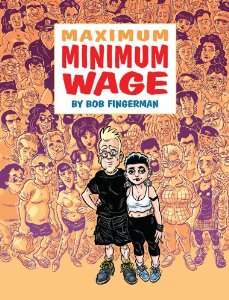 Maximum Minimum Wage by Bob Fingerman (Image Comics, 2013)
Seemingly people have more time to read in the summer but, for me, I tend to find that the opposite is true. Therefore you’ve got to love the existence of graphic novels. Much like a movie, the average graphic novel only asks the reader for an hour or two.
With Fingerman’s “Maximum Minimum Wage,” we see through the eyes of Rob Hoffman, a cartoonist working on smut rags to pay the bills, as he, alongside his girlfriend, Sylvia, go about the apathy of their oddly relatable lives. It looks like Fingerman’s series channels other comix writers like Daniel Clowes and Brian Wood. During the heated summer months, I tend to go for narratives that point at the bleakness of modern life with a lot of sarcasm and, as the back cover blurb states, “cringe humor.”
5 Comments
June 3rd, 2013 / 11:00 am
June 3rd, 2013 / 11:00 am
LIES/ISLE PRESENTS: Morning by Lara Mimosa Montes
In the morning she ties her robe
so now the morning is
a mélange of peachy pinks to me
If this mélange could only be poured into her demitasse
so now the morning is
a mélange of peachy pinks to me
If this mélange could only be poured into her demitasse
all your peach-noir-pink
pouring it into me
If it’s dark enough
dream time dawn colored enough
Yes, looking at you now is like waking up from the dream
with the bottle of crème de menthe still in my hand
But a bad morning is a bitter morning
in your mouth is the taste of chickory to me
If before you go
would you wake up again?
Wake up like a Will Cotton
framed in gold, yawning
but when I call you a Will Cotton
try not to open your mouth please
When I call you a Will Cotton
I am telling you that in the morning
around half-past ten
you look like a 17th century Dutch still-life to me
with your peach languor perversely
idling without end
or if at the end
you and your eggs Florentine
or if at the end
only a bunch of silly papers
. . . . and the glass of orange juice next to the eggs Florentine . . . .
*****
If you are a white elephant, they say, then you are actually naturally pink
. . . . . . . . . But if you are a glass rinsed with bitters, then filled with gin . . .
Will Cotton, Cotton Candy Sky (2006)
Ben Mirov—
How do you feel about the writing scene in your city? Does it make you stronger, or does it sap your will to live like a giant lamprey?
21
Gimme Gimme “Kure Kure Takora”
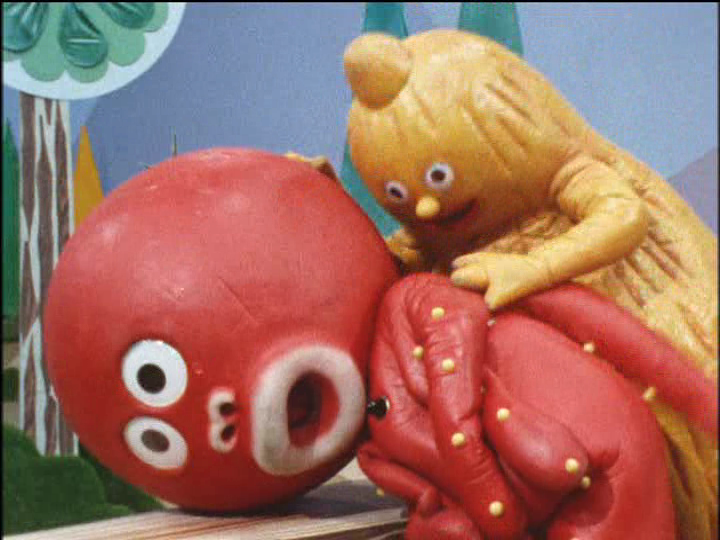
My last two posts here have been about recent deaths so here’s something lighter (?). Today a friend of mine turned me on to this crazy 1970s Japanese children’s TV show, Kure Kure Takora (commonly translated as “Gimme Gimme Octopus”). The main character is a giant red anthropomorphic octopus who covets everything he sees (and who might be based on minstrel show imagery? I can’t quite tell). He’s in love with a pink walrus and his best friend is an oversized gourd that periodically vomits coins. Other characters include a vinegar-spraying jellyfish, a cigar-smoking badger, a lazy iguana, and a trio of singing sea cucumbers. Wackiness, obviously, ensues. According to the Wikipedia there are 260 episodes, each one exactly 2 minutes and 41 seconds long.
You can watch one of them here and another one here. A DVD collection is also available for purchase or theft. And presumably it won’t be long before someone sets one of the episodes to a certain song by the Ramones.
Enjoy / forget for a while we’re all gonna die.
The Crisis Of Infinite Worlds by Dana Ward
 The Crisis Of Infinite Worlds
by Dana Ward
Futurepoem Books, May 2013
160 pages / $16 Buy from SPD or Amazon
Once upon a time in the 1990s, I remember my 4th grade class being spoon-fed articles from Time For Kids magazine about how dangerous drugs like ecstasy and MDMA were (“Like taking an ice-cream scoop’s worth out from your young brain!”) and there was this evil thing called a rave. Like your average party, maybe with music and multi-colored lights and everybody dancing, but worse. Like the mythic days of 60s experimentation with hallucinogenics à la professor Timothy Leary, only much more fatalistic. An altogether different hedonism, or what could be called decadence: not even grunge, but a kind of positive nihilism and saying goodbye to the 20th century. These concepts were so far beyond my imagination and/or realm of consciousness at that time, that I wrote it all off as a cautionary tale that didn’t in any way apply to me. Now, flash-forward to the second decade of our new millennium, and I have tried MDMA, but I’ve never been to a rave before, at least none that I can remember…
Dana Ward is an archeologist of these and other esoterica with a poem about Krystle Cole at the proverbial core of his latest full-length book from Futurepoem. VICE Magazine online is currently another go-to source for information about her (short documentary here) but you don’t have to be in-the-know about anything like that to enjoy this poem, or the book. I first read the following verses in a little handsewn magazine made in Brooklyn over a year ago, when the rest of this book was just a glimmer in the author and its publisher’s eye. The poem began the magazine. Here’s a part of the middle:
“The connections felt
besieged or like a mask
for separation, they
felt like connection
between us in life but I
didn’t take my allegory
further Krystal Cole, into your
lysergic delirium later redeemed
by a beautiful discipline
of spirit & cosmography
developed for praxis. I liked
your video on candy
flipping hard & developing
telekinesis with friends.
It suggested oneness
was a leavened mix
of random indiscretion,
bruising wariness, & bliss
obtained by synchronizing
chemical encounter [. . .] “
besieged or like a mask
for separation, they
felt like connection
between us in life but I
didn’t take my allegory
further Krystal Cole, into your
lysergic delirium later redeemed
by a beautiful discipline
of spirit & cosmography
developed for praxis. I liked
your video on candy
flipping hard & developing
telekinesis with friends.
It suggested oneness
was a leavened mix
of random indiscretion,
bruising wariness, & bliss
obtained by synchronizing
chemical encounter [. . .] “
1 Comment
May 31st, 2013 / 11:02 am
May 31st, 2013 / 11:02 am
Tool. by Peter Sotos
 Tool.
Tool.
by Peter Sotos
Nine-Banded Books, Feb 2013
146 pages / $13 Buy from Amazon or Nine-Banded Books
DISCLAIMER: This book and my review will offend almost everyone.
Tool. is a hard go. That’s the short of it. In a culture where books are already often marginalized as entertainments or, when not entertainments, as “literature” (a term Sotos hates)—here meaning a kind of artful comment on or discourse with the world—where, at best, the book offers polite critique through lenses that are prescribed by the systems these books claim they challenge—in this culture Peter Sotos will be dismissed outright, both as a writer and as a person, a distinction that’s probably pointless because Sotos has been endlessly vigilant about claiming that, for him, there is no distinction.
That honesty also works to assure he has little footing to stand on in the larger literary conversation. And maybe it should stay that way. I won’t claim it shouldn’t. But all of this leads me to conclude that Sotos may be one of the only writers I can point to, perhaps the only one with so immediate a method, who has made a lifelong project of problematizing the existence of monstrous selves in relation to larger groups: societies, neighborhoods, families. He refuses to deny these selves, refuses to box them up, refuses to refuse access to the components of these selves that exist within his self. And this seriously pisses people off (check out this conversation on the Electrical Audio Message board for tangible evidence)
This reaction, though small, interests me in a number of ways. I’m always curious to encounter ideologies we’ve erected that seem to be beyond taboo. Sex with children, let alone cruel and fatal sex, is a supposedly clear line in the sand, one you do not cross under any circumstances. That Sotos seems interested in using his foot to not only smear that line, but to tunnel into the sand beneath it out onto the other end, elicits active hostility. But, more than this, I’m also curious about why no one seems interested in pointing out the empathy that exists at the bottom, and not just, haters would assume, for the perverts, pedophiles, child murderers, and monsters that populate his work. Certainly, at least in Tool. anyway, there exists a strong, obsessive desire to understand the victim, the impossible other that makes existence excruciating.
4 Comments
May 31st, 2013 / 11:00 am
May 31st, 2013 / 11:00 am