Quick Thoughts on the Penguin Random House Merger

Business-Deal-600x2751

Hi, this post was in my drafts. For some reason I was too shy to post it. So it’s old news as of like February 20. So sue me.

Naturally Dennis Johnson has some dreadful things to say about the Penguin Random House merger, calling it “one of the most important publishing and cultural stories of our lifetime.” He points to the lack of coverage in the news as a big downplay, and the scandalous lack of government oversight as something that’s hard not to see as a conspiracy.

The first page of André Schiffrin’s The Business of Books discusses how, when Random House acquired AA Knopf in 1960, the DOJ started looking into the merger—until they realized that the combined companies would be worth only $15 million. Why’d they take an interest? Because it was front page news, which isn’t the case anymore (though the combined value of Penguin Random is $3 billion). Why is this Times article, about the US regulator’s approval of the merger, so short? READ MORE >

Behind the Scenes & Presses / 3 Comments
March 25th, 2013 / 11:14 am

The difference between a concept & a constraint, part 2: What is a constraint?

perec-puzzle-piece

OK, back to this. In Part 1, I traced out how in conceptual art, the concept lies outside whatever artwork is produced—how, strictly speaking, the concept itself is the artwork, and whatever thingamabob the artist then uses the concept to go on to make (if anything) counts more as a record or a product of the originating concept. (This is according to the teachings of Sol LeWitt, as practiced by Kenneth Goldsmith.) Thus, we arrived at the following formulation:

  • Artist > Concept > Artwork (Record)

Now, I’m not going to argue that every conceptual artist on Planet Earth works according to this model. But LeWitt’s prescription has proven influential, and continues to be revolutionary—because choosing to work with either a concept or a constraint will lead an artist down one of two very different paths. To see how this is the case, let’s try defining what a constraint is, aided by the Puzzle Master himself, Georges Perec . . .

READ MORE >

Craft Notes / 12 Comments
March 25th, 2013 / 8:01 am

Chasing the Red Herrings in Greenaway’s Z+OO: a symposium of myself

SurrealZorses

It starts with a crash. You do not see the crash. You hear it. You see the aftermath. Typical. A dead swan splayed over the hood of a white Ford Mercury. The first time I typed that, I typed Mercy. Different cars are very much different sorts of animals. Domesticated animals, of course. Crossbreeds. It is said that the different sorts of hominids did not, could not, cross. Put that in my zonkey’s ass. The woman driving the car, who will be accused of taking mercury to procure an abortion, is named Bewick. The Mercury is no longer produced. You could say it is extinct. It was Ford’s answer to the Buick, you could say it was a fake Buick, a car that would no longer be were it not for waning appeal among wealthy Chinese (the last Emperor drove one, so did my grandma). Rauschenberg was born in the same town as my mom. This scene, the first of A Zed & Two Noughts, looks like something he might have filmed in the sixties, if only he had combined his interests (visual & performance art) into film, the way he did with found objects, like his notorious American bald eagle (an animal that will be mentioned later in this film when a prostitute named Venus de Milo asks the zookeeper for the tail feathers of that bird in order to write a dirty story, the same zookeeper who will later threaten to tell the director of the zoo, who is in fact the director of the film, about the brothers bringing the dead dalmatian into the zoo because it is “an abomination”). But then Rauschenberg dealt with death in ways more conceptual, less actual. I remember riding in the back of my grandma’s Buick because it had a passenger-side airbag. I remember carefully visualizing my death. I remember oak trees. The accident happens on Swan’s Way. Way is one of the ten most common words in our language. Weeks ago, this surprised me. But it should not be surprising that the journey is more popular than the destination. We’re a restless race. We want tiggers in our tanks & Michael Nyman to speed up & O will he!

zed_still_27

READ MORE >

Film / 1 Comment
March 24th, 2013 / 11:48 pm

Office Psycho

office1

I once temped in the “equity research” department of a large investment firm. I had to be there at 6:30AM PST, given that markets open at 9:30AM EST in New York. Seeing the sunrise from the train felt romantic, the graffiti scratched windows cutting the sun. Daily fluctuations in the market function as a myth; the only two numbers that count are how much you buy and sell, the latter in theory exponential to the former. The gentlemen for whom I worked — my entire job consisted of printing out stock reports and making binders out of them — were all younger than me, with better educations, abs, and weekend plans. They kept me at a cordial distance yet treated me with intuitive bro code sympathy. I exuded humiliation, hiding whatever morose novel I was reading. Short of inviting me to lunch, they asked if I wanted the leftover fries upon their return. Greasy fingered and self-loathing, I printed the fuck out of various stocks — whose sudden peaks and valleys told the bipolar story of our free market — while eavesdropping on tales of roughly coordinated fellatio in sports cars during metered parking. A quarter buys diminishing time, guaranteeing itself business again. I wondered who these women were, their red lipstick further deepened by a $24 dollar glass of Côtes du Rhône seeming as blood under a sole candle flame wavering inside glass. And this is just happy hour.

READ MORE >

Random / 7 Comments
March 23rd, 2013 / 2:55 pm

Donald Richie and the Japan Journals: A Tribute

Peter Tieryas Liu previously wrote about Donald Richie and his Japan Journals on HTMLGIANT (read the full review here).

And now this great video:

Author Spotlight / 3 Comments
March 21st, 2013 / 9:29 pm

Reviews

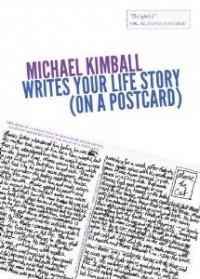
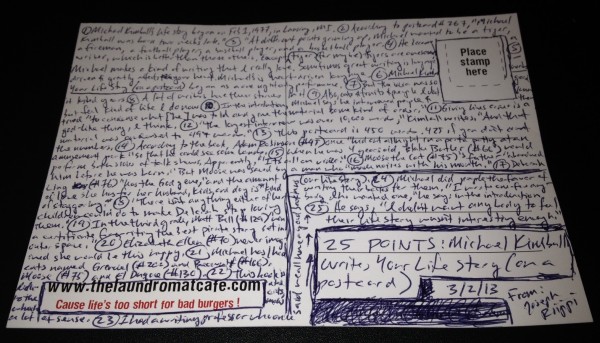
25 Points: Michael Kimball Writes Your Life Story (on a postcard)

mkpostcardMichael Kimball Writes Your Life Story (on a postcard)
by Michael Kimball
Mud Luscious Press, 2013
162 pages / $15.00 buy from SPD or Amazon


MK Postcard Back
READ MORE >

2 Comments
March 21st, 2013 / 12:09 pm

In case you’ve missed it, Kent Johnson’s gone after Marjorie Perloff (PDF) for her entry on “Avant-Garde Poetics” in the Princeton Encyclopedia of Poetry and Poetics, 4th ed. Writes Johnson:

[With] exception of a passing reference to the Brazilian brothers Augusto and Haroldo de Campos and their Concretista moment, not a single poet or group outside the Anglo-American/European experience is acknowledged. The entire Iberian Peninsula, even, goes missing!

Among those missing, he argues, are Vicente Huidobro, César Vallejo, Aimé Césaire, Kitasono Katue, Alejandra Pizarnik, and Raúl Zurita—plus he takes a few swipes at Conceptual Poetry and Flarf. Well worth reading.

An Interview With Donald Ray Pollock

urlSeveral years ago I was about to board a plane to Virginia where I was to explore the campus of a school that would teach me to become a mortician. It’s since become a joke in various places that ‘I’m here, because my job as a mortician fell through…’ etc. Before boarding the plane, I grabbed a magazine—my memory eludes me as to which magazine it was, some cultural blah blah blah; something where books are mentioned—and during the two or so hour ride I read most of the magazine, finally rereading one portion over and over again.

It was a blurb written about a novel called The Devil All the Time, with corresponding cover art featuring mangled marker-drawn crosses and skulls; and a glowing review from somebody somewhere. The writer’s name was Donald Ray Pollock, a name most people recognize along with the titles of his books nowadays.

Again, didn’t wind up becoming a mortician, but on that trip I stopped at a bookstore and picked up a copy of Pollock’s second book, reading it from cover-to-cover on the plane and car ride back to the middle of nowhere in Wisconsin; and for the first time in a long while I started to find romantic little moments along the barren roads beside our car, having Pollock’s eyes to see that you didn’t need New York to have literature, I guess, that sort of thing.

A month or so later I was cursing myself, finding out that Pollock’s first book, Knockemstiff, was sort of a prerequisite for the second—set as they both are in similar vistas of rural Ohio, where everything reeks of old death and strange blood. I picked up a paperback copy of his first as soon as I could and immediately set to reading it.

Both times, in similar and yet subtly different ways, I was floored. Knockemstiff reads as if Raymond Carver and Dennis Cooper had a kid and he lived down the street from Scott McClanahan; gloriously fucked-up images balanced against the monotony and odd sense of peace you get when you’re so far off the radar that you forget it even exists. This is Pollock’s coming out into the world of literature, and he does so with no shit-covered stone unturned. With his second, The Devil All the Time, it could be said that Pollock prolonged the sting of his previous short stories and the result is a portrait of American life nearly impossible to forget. The book opens with a father and son walking out to a small grove where they’ve been sacrificing animals, hoping for some kind of good fortune, and from then on it barrels headlong into a story spanning many years and veering off into these dirty cinematic takes on growing up, dealing with death, and out-and-out crime.

READ MORE >

Author Spotlight / 6 Comments
March 20th, 2013 / 12:00 pm