“There are people who say, ‘If music’s that easy to write, I could do it.’ Of course they could, but they don’t. I find [Morton] Feldman’s own statement more affirmative. We were driving back from some place in New England where a concert had been given. He is a large man and falls asleep easily. Out of a sound sleep, he awoke to say, ‘Now that things are so simple, there’s so much to do.’”
—John Cage, Indeterminacy
100 things to do when you have the time
Doodle. Look for new styles, new approaches.
Draw a picture of a friend. See how many different ways you can do it, such as how few lines you can use.
Recite something you once memorized: a poem, a song, a story, a monologue.
Memorize something new.
Write a review of something you like.
Go over the steps in a procedure or a process.
Explain to a friend a thing you know, or think you know.
Write a song, or cover a song.
List the projects you’re working on, or want to work on. Set a deadline for completing one of them.
Review every thing that you’ve done in the past week, the past month, the past year, the past five years, the past decade.
Reread your diary or journal. If you don’t keep one, reread old sent emails.
Describe something in as many words as possible, then as briefly as possible.
Make up a riddle or joke.
Make a puzzle for others to solve.
Play a Dadaist/Surrealist/Oulipian writing game, such as automatic writing, the Exquisite Corpse, the Cut-Up Technique, homophonic translation, lipograms, …
Write a story or poem entirely in your head.
Observe whoever is around you. Note what they’re doing.
Observe how the energy levels in a room change over time.
Perform John Cage’s “silent piece” (4’33”). Pay attention to both the aural and the visual.
Perform random FLUXUS pieces, then try inventing new ones.
List all of your interests. Prioritize them.
Compose a view.
Explore a texture (a fabric, a liquid).
Examine a nearby text. Why is it the way that it is?
Explore a space: a room, a building, a street, a city.
In the beginning God Sr. made God Jr.
because everyone needs to come
from somewhere.
That means God Sr. just appeared
& that wouldn’t make any sense.
Know this book doesn’t make any sense,
but neither did the first one.
Still, follow me.
Tucking God Jr. into bed, God Sr. tells him
I hope you dream about stupid zombies
instead of martyrs being eaten by lions.
God Jr. is scared of lions because thoughts
of the future are worse than thoughts of the past
when the past is just beginning, like fourteen
lines ago beginning. (more…)
You may or may not be familiar with the brilliant, confounding, and now frequently imitated work of Ryan Trecartin. He is perhaps the most important artist of this decade. I’m not the first to say so. Here is one of his popular videos.
In the course of my commercial work, I came accross a video produced by a team associated with the Blissdom Blogger conference, defined in the About section of their website as “the premiere conference for women who find and express their bliss by publishing online.” OK, what?
NOON Annual 2012
Ed. Diane Williams
$12 / Purchase directly from NOON
After reading NOON Annual 2012, I again dwelled on the nature and the value of the short-short story. I despair that short-short works are sometimes disparaged as underdeveloped and unworthy, and this issue of NOON proves the perfect response to such cynicism and dismissals.
First, the design and aesthetics of this literary magazine are first-rate. The book is smooth to the touch, bears weight, and courts the eye. There’s a smell from these pages that, while not pleasant per se, is definite. Definite is not to be underrated. This book is elegant and glamorous. Even the spine is a standout. I pored so long over Bill Hayward’s black and white photograph on page 107, the work bears my countless greasy prints. I love how the subjects here seem afloat, as if there is no ground, as if the whole point is to throw out our assumptions and re-see. Animal portrait photographer Valerie Schaff’s cover is memorable and her self-portrait on the inside cover is stunning and affecting. She writes, “When I am present, I am beyond the notion of predictability.” This quote proved my guide for the reading and the appreciation of the entire issue.
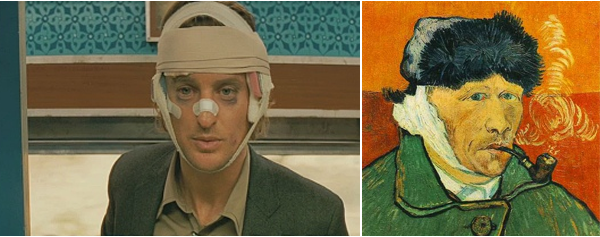
On August 26, 2007, Owen Wilson was taken to a hospital in Santa Monica, California, after slashing his wrists in a suicide attempt. A friend tells People magazine “he almost did not make it”; that Wilson’s near fatality was reduced to a cliché in a glossy may be the reason why he questioned his life, or we might question ours. Wilson had also recently broken up with Kate Hudson, so she may consider herself flattered. The truth is we will never know what went on in the mind of a made man. The money and success just not enough. Months later, The Darjeeling Limited (2007) was released, in which Wilson — his character having just suffered a horrible motorcycle accident — is seen ineffectively wearing a bunch of gauze. He and his brothers went to find their father; not his corpse, but emotional legacy. Owen’s real life brother Luke Wilson has his own suicide scene in The Royal Tennenbaums, his wrists streaming blood over curly locks of cut hair in Starry Night blue. On December 23, 1889, Vincent Van Gogh cuts off his ear (or merely the lobe, he claims) in a brothel, and hands it to a prostitute for safe keeping; Gauguin is to find him later on that night in his bed covered in blood. Some art historians propose that it was actually Gauguin who did it during a heated argument; others say it was Van Gogh’s clingy response to Theo (his brother and sole patron) getting engaged. To others, simply a bad night with a hooker. The truth is we will never know what went on in the mind of a mad man. In another similar self-portrait painted presumably that week, or even day, for he wears the same outfit, a Japanese print on the wall behind him shows two mothers and their children situated immediately next to his good ear, whispering over waves.


 NOON Annual 2012