On nihilism

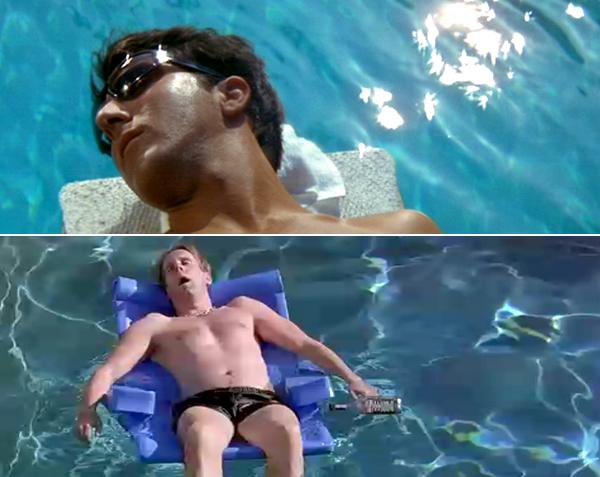
Williams College is a liberal arts college in Williamstown Massachusetts, from which Charles Webb, who wrote the novel from which Nichols’ The Graduate (1967) was adapted, graduated. He is oddly, or expectedly, not associated with the film’s success. He is married to Fred, who calls herself that name in solidarity with Fred, a support group for women with low self-esteem. His homeschooled children, now adults, sold their wedding presents back to their guests, each got divorced in protest against marriage, and now, rumor has it, work at kmart and live in a shack. “The Sounds of Silence,” (1965) enmeshed with the iconic pool scene, forty-six years after it was was released, would be performed by a visibly distraught Paul Simon at the 9/11 Anniversary Memorial Ceremony, wearing a suit of out respect but looking like he’s going in for a job interview. Benny is seduced by an older woman but falls in love with her daughter, played by one doe-eyed Katharine Ross, who seventeen years later would end up marrying Sam Elliott, the omniscient narrator of The Big Lebowski (1998), whose appearance as The Stranger at the film’s ending can be seen as a pedestrian second coming of sorts, which is an odd way for Marco Polo, or you, to wade across the chlorine to one Uli Kunkel (screen name “Karl Hungus,” who appeared in a porn film with Bunny) seen passed out next to empty Jack. I like it how, in bars or parties, a group of exclusively males standing in a circle will shoot straight whiskey or tequila — suddenly throwing their heads back as synchronized swimmers — followed each by a coy yet uncontainable grin, as if the word cool could not contain what had just happened. “Uli doesn’t care about anything. He’s a Nihilist,” soon-to-be 9-toe’d Bunny Lebowski says. “Ah, that must be exhausting,” goes The Dude, whose $0.69 personal check to Ralph’s for some milk in the opening scene was dated September 11, 1991, exactly 10 years before the event exactly 10 years before Simon’s sad song was sang again through the bravery of a non-facelifted face. As for that day, they said we were nihilists, so we said they were back. People talking without speaking.

Film / 15 Comments
January 12th, 2012 / 7:27 pm

If the dictionary is a graveyard, writers are either necromancers or necrophiliacs

READ MORE >

Craft Notes / 7 Comments
January 12th, 2012 / 6:33 pm

The Hero’s Body

This post is an essay about comic books and sex. These are things I am thinking about because of a book I am writing.

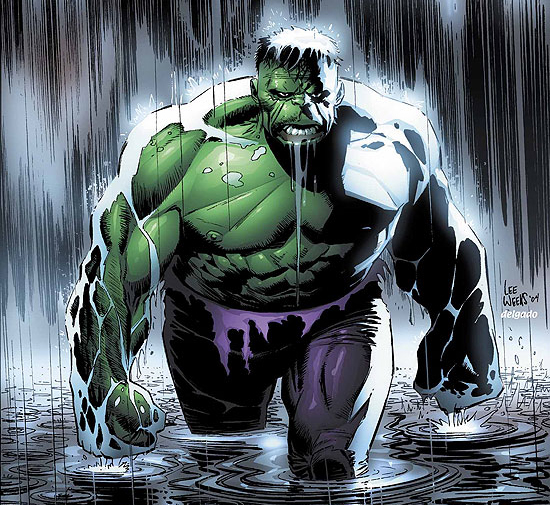
In May of 1962, the brilliant scientist Bruce Banner rushed into the site of an experimental gamma bomb detonation in order to save a teenager, young Rick Jones, from the blast. Banner stood at the blast’s center. His body absorbed a massive dose of gamma radiation. Banner soon found that when he lost control of his temper, he would become the Hulk, a super-strong, bulky monster with green skin and the collective smarts of a box of rocks. The Hulk was originally more of a monster than a hero, back when monster books still sold; Stan Lee created him by combining him with Frankenstein’s creature and the Hyde of Jekyll and Hyde. He also compared him to the golem. The Hulk looks like this:

READ MORE >

Random / 13 Comments
January 12th, 2012 / 3:31 pm

The Knox Writers’ House is a kind of insane expansive recording projects where three rad people went all across the U.S. interviewing and recording writers reading their work and work they love. Literally hours upon hours of audio & text content from a huge array, from Heather Christle to Carole Maso.

Interview with Leigh Stein (3 and 4)

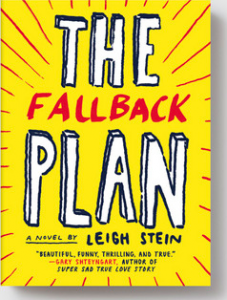
Leigh Stein’s meaningful first novel, The Fallback Plan, is about a girl named Esther who has just graduated from college and is feeling aimless and depressed, which, okay, sounds like a well-visited premise for a novel. But Esther is so witty and likable that you can’t help enjoying her mild misadventures. I’ve been emailing a question to Leigh every day this week, but yesterday she was caught up on her book tour (is she in your town?), so here are two questions

HTMLGIANT: Can I tell you something? Why is the novel so funny? Or, seriously, what was the writing process like? How many revisions did it take to get all the jokes in there? Like, “A small part of me threw up.” Or making a confused facial expression to trick the IPASS sensor, or a mom with a “hairstyle most conducive to storing pencils” instead of one who says “well look at that” when you show her how to enlarge the type in MS Word.

LEIGH: Esther makes jokes as a way of pricking the bubble of despair and stagnation she lives in, because that’s what I do. READ MORE >

Author Spotlight / 2 Comments
January 12th, 2012 / 12:56 pm

HTMLGIANT Features

“C, Clown”: An Excerpt from Gwenaelle Aubry’s No One

I’m five or six, on holiday with my father at his parents’ place in Soissons. My grandfather is seeing patients in his surgery at the end of the garden, my grandmother is busy doing I don’t know what, I’m alone, I’m bored. Suddenly I have an idea. I get my grandmother’s lipstick from the bathroom and I set about painting my father: two circles on his cheeks, another on the end of his nose. I take him by the hand and say, “You’re a clown, Dad, come on, I want to show everyone.” Together we go out into the street and sit down on the doorstep in the blazing sunlight of a summer afternoon. He’s in profile. With my finger I spread the color over his left cheek. He lets me do it with a weary, nasty smile. Seeing him like this I’m filled with shame, sorrow, and pleasure. My grandmother suddenly appears from nowhere, a small, elegant, measured woman, her dress, makeup, and hair always just so. For the first time I hear her raise her voice. In a tone that brooks no answer she orders me to stop it at once, to go back inside.

Twenty-five years later, when my grandmother was long dead, my father went back to live, or rather to stop living, in Soissons. He moved into an apartment with his father. After my grandfather’s departure and subsequent death a few months later, my father was hospitalized in a clinic right opposite the house he grew up in. It was then that he really went downhill. READ MORE >

3 Comments
January 12th, 2012 / 12:01 pm

James Franco + Hart Crane

Two posts in one day after not posting for a century, but then I saw this:

James Franco, Hart Crane, discuss.

Film / 36 Comments
January 11th, 2012 / 5:00 pm

MFA fiction workshop syllabus

So, I’m teaching my first MFA fiction workshop this spring, which is exciting and pretty cool. I’ve decided to play with the traditional workshop model, which is two submitted stories per term. Here’s the syllabus.

ENGL 574 Syllabus

COURSE DESCRIPTION: This will be an intensive graduate workshop. I am working with a different model, one that emphasizes both generative practices and revision. You will be required to write three new stories very quickly (during the first nine weeks of class), which we will workshop, then we’ll spend the last five weeks of class workshopping one revision. It doesn’t take a mathematician to realize that we will be “flying” through the stories in the first part in order to focus our time on the revision.

READ MORE >

Behind the Scenes / 69 Comments
January 11th, 2012 / 1:22 pm

salt water pepper spray shakers

a poem written by a bear by Tao Lin.

Bear Costume by Steven Miller, with bonus baby carrot.

From “Obliterating Animal Carcasses with Explosives,” a pamphlet issued by the Technology and Development Program of the U.S. Forest Service.

There are times when it is important to remove or obliterate an animal carcass from locations such as recreation areas where a carcass might attract bears, at a popular picnic area where the public might object, or along the sides of roads or trails. Explosives have successfully been used by qualified blasters to partially or totally obliterate large animal carcasses (horses, mules, moose, etc.). It is important to consider location, time of year, and size of the carcass when selecting the quantity and type of explosive to accomplish the obliteration task. The following instructions pertain to partial obliteration (dispersion) for a horse that weighs about 1,100 pounds. In this first example, urgency is not a factor-perhaps the public is not expected to visit the area for a few days, or perhaps bears will not be attracted to the carcass. In any case, in this example, dispersion is acceptable. Place three pounds of explosives under the carcass in four locations. The carcass can then be rolled onto the explosives if necessary. Place one pound of explosives in two locations on each leg. Use detonator cord to tie the explosives’ charges together. Horseshoes should be removed to minimize dangerous flying debris. In situations where total animal obliteration is necessary, it is advisable to double the amount of explosives used in the first example. Total obliteration might be preferred in situations where the public is expected in the area the next day, or where bears are particularly prolific. Carcasses that have been dispersed will generally be totally gone within a few days. Carcasses that have been obliterated will generally not show any trace of existence the next day.

The Bear (Jim Harrison)

When my propane ran out
when I was gone and the food
thawed in the freezer I grieved
over the five pounds of melted squid,
but then a big gaunt bear arrived
and feasted on the garbage, a few tentacles
left in the grass, purplish white worms.
O bear, now that you’ve tasted the ocean
I hope your dreamlife contains the whales
I’ve seen, that the one in the Humboldt current
basking on the surface who seemed to watch
the seabirds wheeling around her head.

Random / 4 Comments
January 11th, 2012 / 9:23 am