Hieronymus Bosch - Garden of Earthly Delights (1503)
Like Joshua Corey & others, I’m bewitched by Joyelle McSweeney’s concept of “the necropastoral.” (read her posts at Montevidayo) I fear I have little to contribute, but much to wonder about. My inclination is to assume I’m misunderstanding what she means by the term, even after reading her definition:
[the ‘necropastoral’ is] a term which denaturalizes the pastoral by focusing on its always/already unnatural qualities. In its classical form, the pastoral is a kind of membrane on the urban, an artificial, counterfeit, impossible, anachronistic version of an alternative world that is actually the urban’s double, contiguous, and thus both contaminatory and ripe for contamination, a membrane which, famously, Death (and Art) can easily traverse (Hence, Et in Arcadia Ego). [here]
But since I’ve never let misunderstanding stop me from asking questions, or engaging in conversation, I thought I would share some thoughts (more bricolage of ideas than exposition) provoked by the evocation of “the necropastoral.”
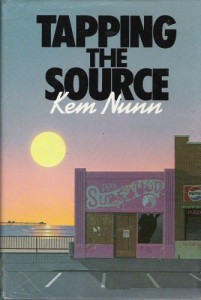 It’s the middle of winter. Everything’s dormant or dead. It’s raining a lot up here in Oregon, as it always does for half the year. I was walking around in my heavy winter coat, grey clouds overhead, and got to thiking about the curative warmth of sunshine, and the golden sexuality of beaches, which left me nostalgic for summer, which got me thinking about the way Nunn’s surf novels had carried me through a similarly dark Northwest winter in 2005, and about how it was pretty tragic how few people seemed to know about Nunn’s books, which, even carrying the bordering-on-corny “surf novel” tag, are dark and deeply engrossing.