

The following conversation between Colin Winnette (colinwinnette.com) and Ben Marcus (benmarcus.com) took place during the brutally mediocre winter of 2011. Both men carved a desk along with extra elbowroom into the walls of their unnecessary ice huts and began a steady email exchange. This was a final attempt to stay warmish. Listed below are the contents of that attempt. Special Thanks to Cassandra Troyan -The Eds.
Ben Marcus is the author of three books of fiction: Notable American Women, The Father Costume, and The Age of Wire and String. His new novel, The Flame Alphabet, will be published by Knopf in January of 2012. His stories, essays, and reviews have appeared in Harper’s, The Paris Review, The Believer, The New York Times, Salon, McSweeney’s, Time, Conjunctions, Nerve, Black Clock, Grand Street, Cabinet, Parkett, The Village Voice, Poetry, and BOMB. He is the editor of The Anchor Book of New American Short Stories, and for several years he was the fiction editor of Fence. He has recently served as the guest fiction editor for Guernica Magazine. He is a 2009 recipient of a grant for Innovative Literature from the Creative Capital Foundation. In 2008 he received the Morton Dauwen Zabel Award from the American Academy of Arts and Letters, and he has also received a Whiting Writers Award, a National Endowment for the Arts Fellowship in fiction, three Pushcart Prizes, and a fiction fellowship from the Howard Foundation of Brown University, where he taught for several years before joining the faculty at Columbia University’s School of the Arts.
*Portions of this interview first appeared in the Winter 2011 issue of the Tex Gallery Review
CW:Could you talk a little about your upcoming book, The Flame Alphabet? Its genesis and where things went from there?
BM: I’d been thinking for years about language as a toxic substance. Language itself making people sick. Speech and text, all of it poisonous. If you read a road sign you get nauseous. That was the original idea, but after Notable American Women I really didn’t want to write another heavily-conceptual, modular book. With that book, every new chapter felt like I was starting over. I wanted to write something continuous, a straight shot powered by one voice. I tried a lot of voices, forms, and approaches, and threw all of it away. But then I was doing some reading on underground Jewish cults and I found a pretty natural way to connect a language toxicity to a really personal narrative, even if that meant liberal falsifications and misreadings, and a story sort of bloomed fast out of that: a husband and wife who are sickened by the speech of their daughter. Literally. So sickened that they have to leave her. A situation so bad you’d have to abandon your child. This really frightened me, and I couldn’t even imagine it, which meant I had to chase it down. That was the opening premise, and once I had that I wrote the book in just over a year.

 Saul Bellow was an old-fashioned man of letters. Part of what that means is that he traded a lot of letters with other people and seemed to have literary aspirations for his letters. I read a review of his newly collected letters which said that since people don’t write letters anymore, this was probably the last rich collection of letters we’d be seeing from a literary man. I doubt this is true, considering the generation after him figures prominently in his letters. I doubt Philip Roth will allow the posthumous publication of his letters, but I bet his letters will rival Bellow’s letters, some of which are to Roth. I also know that writers even from my own generation are still trading letters with the likes of, say, Don DeLillo. And I’ve seen the treasure trove of Raymond Carver’s correspondence in the Charvat collection at the Ohio State University, where I had to sign a form saying I wouldn’t tell you what was in them, but, listen hot-shit literary biographers interested in Carver’s era: There is stuff in there that will make your hair stand on end. There was a fair bit of nastiness flying about our nation’s postal thoroughfares in Carver days.

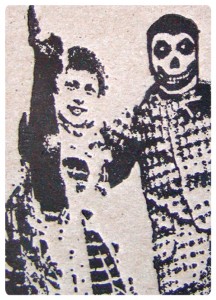 Dear mother…just now I am at the foot of a bone bridge. I shall be crossing it shortly. I don’t know if I shall find hills and valleys made of flesh on the other side, or simply constant night, villages of sleep. The seam of the open book on the bridge of my nose, two dense board covers pressing down the pages over my eyes on a bed in a basement dug into a planet. The spine of the book a roof peak for my face-house. Or a lid. It fits pretty good. I feel safe, take a nap. No, no, dummy, you are not designed to hurt me; I am designed to hurt you…Prominent stencils I remember in DC: some gorilla head, the Borf face (his dead friend?), like targets on specific lamp posts in Georgetown—as if the graffiti artists want you to remember there used to be punk shows there. And on Jake Levine’s (Chap A) cover—the black ink pressed into the brown paper board. Some kind of guy in a flannel suit with a smiling skull mask holding one foot up at head level? As if I’ve seen it through a metro window on some concrete barrier in Northeast?