
Story by Chelsea Martin. / Written for the screen and directed by Riley Michael Parker / Starring… Marika Haskins, Lauren Emery, Noah Emmet, and Nathaniel Applefield as “Uncle Mitch” / Metazen
Bernhard the Ever-Quotable
From Thomas Bernhard’s The Loser:
We study better in hostile surroundings than in hospitable ones, a student is always well advised to choose a hostile place of study rather than a hospitable one, for the hospitable place will rob him of the better part of his concentration for his studies, the hostile place on the other hand will allow him total concentration, since he must concentrate on his studies to avoid despairing, and to that extent one can absolutely recommend Salzburg, probably like all other so-called beautiful towns, as a place of study, of course only to someone with a strong character, a weak character will inevitably be destroyed in the briefest time.
Quiet City by Connor O’Brien

Quiet City, a wonderfully designed collection of stories by Connor O’Brien, is available for purchase, or, provocatively, pay-by-tweet or -facebook, where the PDF is made available after tweeting/facebooking it. O’Brien, in our correspondence, says:
The book is a bit of an experiment in selling literature online (it actually doubles as a test case for my PhD thesis on publishing) […] the online editions use social networking as currency: you pay with a tweet or facebook post. As a happy coincidence, the title story imagines a world in which social networking stats have superseded cash, so there’s a bit of an interesting tension there — the fiction creating the reality.
Geography Thursday: people as ‘functions of landscape’
In Jeff Malpas’s excellent book, Place & Experience: A Philosophical Topography, he writes:
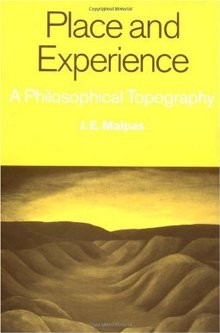
In Proust’s work, persons and places intermingle with one another in such a way that places take on the individuality of persons, while persons are themselves individuated and characterized by their relation to place; persons come to be seen, to use a phrase from Lawrence Durrell, almost ‘as functions of a landscape’ – in some cases, even of a particular room or setting. In fact, the narrator of Proust’s novel, Marcel, grasps his own life, and the time in which it is lived, only through his recovery of the places in relation to which that life has been constituted. Remembrance of Things Past is thus an invocation and exploration of a multitude of places and, through those places, of the persons who appear with them.
What do you think about this? Should our characters be ‘functions of landscape’? How does thinking about characters – especially in Proust – in this way alter our experience of a text? Are we – real, live human beings, as opposed to our fictional characters – functions of our landscape?
Commence arguments.
Interview: Bryan Charles
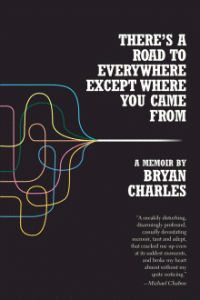 I read Bryan Charles’s memoir, There’s a Road to Everywhere Except Where You Came From, in that non-stop way that feels like your life depends on it. (A few months ago, Justin ran an excerpt of it.) It was a little funny, a little lonely and a little unsettling, but when one chapter ended I moved on to the next as it I was starved for it. Maybe this is the definition of a compelling voice, one that just makes you listen even when you don’t know why. A friend who had also read There’s a Road, as well as Charles’s novel described him as a particularly earnest writer, and I have to agree, so maybe that’s another reason I read so intently—an earnest voice among shelves and shelves of ironic ones. This interview was conducted over email.
Catherine Lacey: This was a weird book to me. I can’t seem to get comfortable with it. It’s been sitting on my desk for a few weeks and sometimes I consider moving it or hiding it, like we’re having a fight or something. A friend told me he thought of your writing as incredibly earnest, and I’ll add brave and unpretentious to that, but there’s also something really emotionally unavailable about the book, which is odd since it’s a memoir. Do you think of it the same way? How did you feel while writing it?
Bryan Charles: The memoir was begun at a point of frustration. I’ve talked about this elsewhere, but I had initially tried to use some of the same material—mostly the 9/11 stuff—in a novel. Once I realized I could actually write a novel, which only occurred to me after I finished my first one, I knew I would use my experience working in the World Trade Center, the attack, and the aftermath in a book in some way. At that time some of the so-called 9/11 novels had come out, or were scheduled to come out, and I felt, rightly or wrongly, that these books, written by people with no direct connection to the attack—except for maybe being in in the city that day—were totally without merit. I was incredibly territorial about it, probably to a fault. I tried to keep a slightly open mind. I read one of those books, the Jonathan Safran Foer book, and I thought it was terrible and should never have been published. It’s an awful, inexcusable novel. I still think whoever was responsible—whichever editor or publisher—for keeping that flipbook thing at the end, with the 9/11 jumper falling upward—whoever let that slide should be fired. Maybe they have been already. READ MORE >
The Pleasures of Cheever
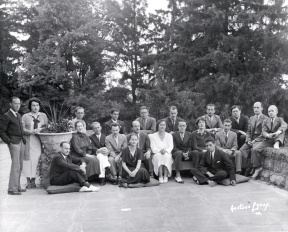
John Cheever, far right on bench, not in California, in front of trees
Some of you might very frequently pick up a book feeling certain that you will like it. This happens to me pretty rarely; usually only when I’ve read the book already, or when it is by Charles Dickens or Virginia Woolf. So it was with particular relish when, still feeling the pang of having no more of Middlemarch to read, I opened The Wapshot Chronicle by John Cheever.
I’d only read Cheever’s stories, which I really love, whether the earlier perhaps more conventional ones or later so-called experiments like “The Swimmer.” Putting aside the question of whether “experimental” is or is not a troublesome descriptor of any art, I don’t think it fits well with Cheever at any stage in his career. One gets the sense with Cheever that he read widely and deeply, probably heavily in Shakespeare and the classics, took what he found useful and then made sentences that were all his own, without giving any thought to fashion and currency.
Sentences like:
We have all parted from simple places by train or boat at season’s end with generations of yellow leaves spilling on the north wind as we spill our seed and the dogs and the children in the back of the car, but it is not a fact that at the moment of separation a tumult of brilliant and precise images–as though we drowned–streams through our heads. We have indeed come back to lighted houses, smelling on the north wind burning applewood, and seen a Polish countess greasing her face in a ski lodge and heard the cry of the horned owl in rut and smelled a dead whale on the south wind that carries also the sweet note of the bell from Antwerp and the dishpan summons of the bell from Altoona but we do not remember all this and more as we board the train.
“Why would people sell themselves short and not just live the life of pure creative glamour.”
httpv://www.youtube.com/watch?v=lQ3SVpE9LTQ
On Friday night I read Dan Hoy’s post over at Montevidayo entitled THE PIN-UP STAKES: Poetry & The Marketing of Poetry. Approximately 2 hours later I was wasted in a bar across the street from my apartment, yelling at my roommate (who doesn’t really read poetry) that it was the best thing ever, insisting that she read it on her smart phone. About two hours after that I tweeted the phrase “If you take the lyrics to pop musick seriously they become the map of utopian society” (the “k” at the end of “musick” is my own superfluous nomenclature that surfaces mostly while “under the influence,” tying music to “magick” of course).
What was in my head, still, other than Hoy’s essay itself, was the video above, and more particularly, the song within the video.
httpv://www.youtube.com/watch?v=bw2o_Go4QWI
No, Fuck You

Ah, the confrontational interview. I had this idea it did exist. Then where has it gone? The jostle, cough, the lip-curl. And without it, haven’t we lost something? To discuss, to pry and fling, not what we’re instructed or allowed (a la Tom Cruise [and many others] who actually inculcate the interviewer in advance—you will only ask these very questions). And so then we have nothing more than a softball game played with bats made of limp, leaking sausages. Toy dogs smelling each other’s asses. A farce.
Because we lose surprise, abrupt honesty, what ego and anger can do: make us blurt out something we might regret, or possess, or shock or please our own self with, something true. But some of this comes down to the medium. Over email, my gods, we can all blurb profound. We cheat, and suddenly I am quoting Beckett and know something about mortgage-backed securities, MFA statistics, and the best clothing option for a casual late fall round of bocce ball (Cabela’s MicroDown soft shell, in hue woodland). An interview over the phone, you might have notes or might be naked (a clear advantage for flow of thought). You don’t see the interviewer at all, the nonverbals, the power of space, but at least it is real time and has potential for nasty, like when Terry Gross asks Gene Simmons about wearing a studded codpiece:
Gene Simmons: No, it holds in my manhood.
Terry Gross: [laughs] That’s right.
Gene Simmons: Otherwise it would be too much for you to take. You’d have to put the book down and confront life. The notion is that if you want to welcome me with open arms, I’m afraid you’re also going to have to welcome me with open legs.
Terry Gross: That’s a really obnoxious thing to say.
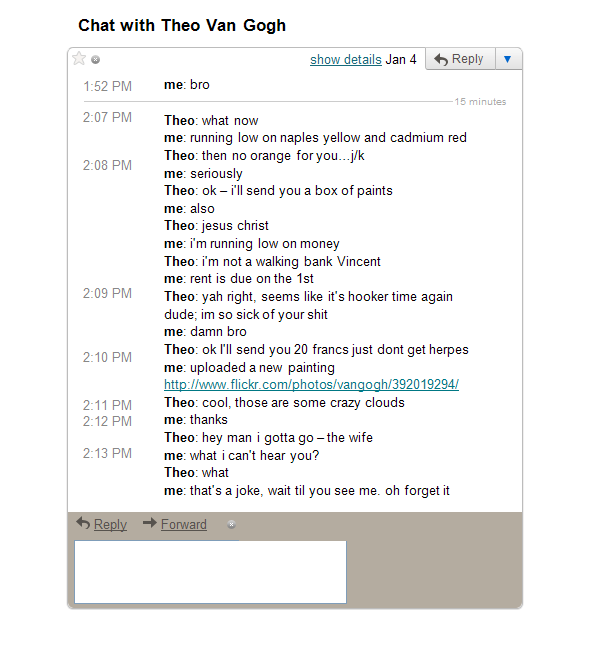
Dan Magers’s WHITE-COLLAR WORKER: I AM A DESTINY
 There’s a new chapbook online at H_NGM_N — Dan Magers’s White-Collar Worker: I Am a Destiny. This one is definitely worth a longer look (and at free, it’s way underpriced). Magers is paying attention to life and giving us not the best sentences to describe it, but the one-liners that best highlight everything else (like, “Someone is having a lot of trouble/in the bathroom.” or “I’m bleeding from the nose. It’s not broken.”) Even if you aren’t — as Magers seems to be — paying attention to arty music and its culture (“The amps are the band. The dudes are the roadies.”) and ramming around with collegiate drunkards (“I have no idea what these kids are talking about./Lacan and baby food.”) you’ll see there’s lots to laugh at and more to find marvelous. I read it quickly and found my reading to be informed by Magers’s early reflection:
Meaning contains a glancing similarity
to what is happening to me.
6 Comments
January 19th, 2011 / 1:18 pm
January 19th, 2011 / 1:18 pm