Just feels so wrong.
(Thanks to Gian for the heads up.)

Just feels so wrong.
(Thanks to Gian for the heads up.)
One of my favorite writers, new or ever, Sean Kilpatrick, has selections from his novel Sucker June online now at Spork. I mean, these are sentences. In the worst way. “He’ll cream himself flowery and miss my big holy penetration.”
I’m updating this post and bringing it up “above the fold” just to, y’know, make sure everyone who’s interested has a chance to comment. It looks like we’re going to be reading MAXIMUM GAGA together and talking about it. Because it’s DIFFICULT.
Original post:
For a while I’ve been thinking, you know what HTMLGIANT needs, it needs — no, you know what the WORLD needs, it needs — no, HTMLGIANT and the WORLD are the same thing — you know what we should do, I’ve been thinking, what we should do is, like, a reading group. READ MORE >
Jonathan Lethem brings us issue 7 of THE THING, a quarterly in object form in which invited artists, writers, etc. create/curate an issue.
Lots of recent activity at the Underground Library, mostly thanks to Dave Clapper and Ellentparker. Feel free to build from what they’ve done or add a new entry. Madore wants significantly to expand the database by the end of 2010.
Seems like people like to edit things down to what offends them a lot of the time. Positive efforts get sometimes burped.
Here’s where somebody did that with the movie Casino, but in a fun way.
It’s okay to have fun.
In-ter-net.
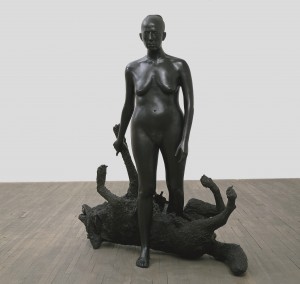 I feel cross-influenced. By that I mean that some visual artists and musicians have as much influence on my writing as writers do, often more. For this reason I want to show you some pictures of work by Kiki Smith, a visual artist who makes incredible objects.
I realize that a lot of HTMLgiant readers might feel like the art world is another planet. It often feels that way if you go to an art gallery opening to mooch free wine or the MoMa on a busy afternoon. Maybe you were stoned all the way through your Art History 101 class in high school or college or maybe you never took one or maybe your teacher was unforgivably snobbish. Maybe it seems like 90% of the “contemporary art” you’ve seen shouldn’t be called art at all. That might be true. I don’t know. I just know there are a lot of living artists that I love because I get that giddy-faced-piss-my-pants feeling when I see their work in real life. Kiki Smith is probably at the top of this list of Artists Who Are Like Writers.
I feel like writers and visual artists have a lot more in common than we often acknowledge. Writing and making objects are lonely endeavors. We’re both trying to get something that is so clear in our brains to be just as clear to other people. READ MORE >
Ani Smith interviews HTMLGIANT contributor Mike Young for Writers’ Bloc. Contains awesome original song.
Blake’s recent post on Towering Literary Figures inspired me to consider a list of significant contemporary (living) women writers. By significant I mean significant to me: women writers who I admire and who I feel have significantly contributed to the advancement of literature.
Perhaps someone else on the Giant staff will take up this theme and focus on writers of color, or GLBT writers, or writers from Australia, or writers with children, or writers still living with their mothers, or etc.
For the record, I understand that what I am doing here is, to a degree, essentialist: by labeling a writer based on their gender I am furthering a world in which these distinctions exist. Furthermore, I completely sympathize with the position that argues that we should not see color or sex or race or whatever, that we should instead see only writers.
But, alas, differences exist.
So, with my disclaimer now fully realized, I give you my list of contemporary women writers that I think kick a lot of ass –(in black&white and in no particular order):
Michæl Chabon can’t keep it up — that wisp of hair that seems to always hang on his forehead all the time. At first glance, one sees a random tuft from a man perhaps too deep in thought to use a comb more than once a day; but I started noticing that these locks made grammatical marks, as if to suggest “don’t just read my book, read my face.” I once went to a Chabon reading at the public library. He called the organizers from his cell phone minutes before the event claiming public transit was crazy. “More fountain water for me,” I thought.
The following is a list of the subconscious syntax of Michæl Chabon’s hair, including excerpts which illustrate said grammatical functions.
1. The Apostrophe
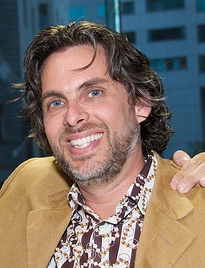
Chabon is not in the business of the avante garde, so there will be no mind blowing today, just a pretty legit use of apostrophes. From The Amazing Adventures of Kavelier & Clay, which won the Pulitzer in 2001:
As soon as the German army occupied Prague, talk began, in certain quarters, of sending the city’s famous Golem, Rabbi Loew’s miraculous automaton, into the safety of exile.
That was a pretty nice use of two apostrophes, both as possessive ones. I tried to find apostrophes used as contractions, but couldn’t, so I’ll put some of my own. I have a feeling maybe good writers aren’t supposed to use contractions. Ain’t that shit.

