
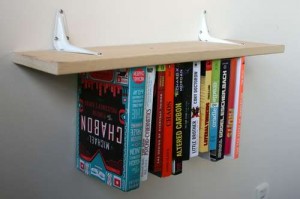
The books here are pretty good or whatever, but what I like is that this bookshelf is functional. Who wants to make me one?
Rate my bookshelf
Ryan Call—
Gary Shteyngart reads/performs a bit from Gogol’s Dead Souls; he first reads in English and then in Russian. Really fascinating to hear it in Russian. The reading was part of 92Y Poetry Center’s celebration of Gogol’s 200th birthday on March 30th.
1
Everything all at once: As a Friend by Forrest Gander
 I’ve been struggling for a while to put into words what I think is going on in the third section of Forrest Gander‘s slim, remarkable novel As a Friend.
The book is broken into four sections. In section one, Les—the book’s subject—is born. In section two, Clay—a friend—talks about the events that led up to his betrayal of Les. In section four, we read comments made by Les, outtakes from a film someone was making about him.
The birth section is an overture—character comes to life and book comes to life at the same time. A moment on the book’s timeline and its consequences.
The Clay section is a look at this remarkable person. Les is a land surveyor and a poet. He is an out-sized individual. Clay is gives readers a longer timeline—Les over the years Clay knew him. It’s also past tense. Clay has some perspective on Les’s life and his death. (Les commits suicide after Clay betrays him by telling Les’s wife about his relationship with another woman.) READ MORE >
Justin Taylor—
I needed a new bookshelf. before breaking down and ordering one from Staples.com ($49.99 for a wooden 5-shelf) I decided to try the thrift store next door to my apartment. They have a ton of bookshelves, apparently NONE of which are for sale. Probably this is because they’re covered in books which ARE for sale. I didn’t need any books. In fact, books are why I was having this whole shelf-problem in the first place. But then, there, sitting on top of a pile (and btw, if you’re just going to pile the books anyway, why not sell me the shelf? piles work even better on floors than on shelves) I spotted Confucius to Cummings: An Anthology of Poetry edited by Ezra Pound and Marcella Spann. Mine for one hot crumpled dollar bill. No tax. From the back cover: “It is a statement by example of the ‘Pound critical canon’ and, as such, a short course in the history of world poetry…” It will have pride of place on my new bookshelf, which Staples will be delivering sometime tomorrow, along with the pink plastic pencil case ($.50) I ordered to tip the total price over the $50 line and therefore earn free shipping.
Genre followup, here and at Tin House blog
Christopher Higgs’ post from the other day, “Tin House & Genre Fiction,” has broken 100 comments. One of those comments is from Tonaya Thompson, the author of the Tin House blog post, “To Genre or Not to Genre,” that Higgs was posting about. Thompson has also written a followup post on the Tin House blog, “Genre Redux.”
Anyone who read my original post as saying that we will discount any piece of writing out of hand is willfully misreading it. And I think that’s because my attack on “lazy” writing put a lot of people on the defensive, especially since I equated that with genre writing.
It’s a good piece, and if you’ve been following the thread, you should definitely read this new post. She seems rather generous to me, in terms of treating her detractors with credulity. She’s certainly more conciliatory than I’d ever dream of being, if similarly treated. (Ironically enough I have an obligation to disclose that I am published in the current issue of Tin House: an essay celebrating Needful Things by Stephen King, the very existence of which would seem to put the lie to a whole raft of commenter claims about TH’s–and my–genre-related biases.)
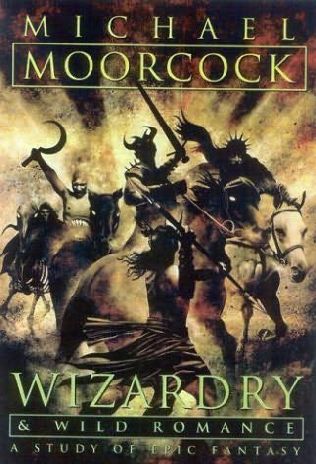
Anyway, for ease of access, after the jump find a copy of Thompson’s comment in the Higgs thread. It’s worth reading the comment before proceeding to the followup post, and you’ll notice that she asks for recommendations of genre writing to read, so feel free to leave those on her blog or on ours. You–or she–could also do much worse, I’d just like to mention, than by reading the Michael Moorcock book pictured above.
Justin Taylor—
Yale University Press is publishing a book about the Danish Mohammed political cartoon controversy from a few years back. But, for fear of violence, this academic study of a dozen political cartoons is being published without the cartoons it is studying. Assholes. But don’t let me get all pissed about this. Here’s Hitch at Slate, pissed enough for all of us.
i like “paradise lost” a whole lot and “paradise regained” a little a lot and i haven’t read “samson agonistes”
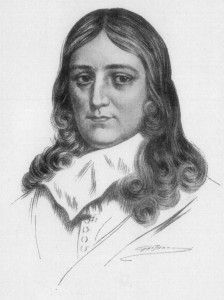
this is a picture of john milton. he looks like if you asked him if he wanted to just rent a super nintendo and chill he would nod once and say, "indeed."
for real though, i like milton. there is no manifest point to this article. i just wanted to tell people that yes, i really like milton. i like milton. i also like that he was blind. i don’t mean that i like blindness is general. but it makes me want to be his friend more (he’s dead though). i think he had his daughters write down his poems as he spoke them. i wonder if he was mean to his daughters or nice. if i was one of his daughters and he was mean i would just write down random shit instead of the actual poems. to recap, i enjoy milton. he makes satan seem really lovable. and in “paradise lost” i liked the war in heaven. he was writing slayer song titles centuries in advance. i like milton.
Uncategorized / 8 Comments
August 17th, 2009 / 11:41 pm
August 17th, 2009 / 11:41 pm
On Hating Thomas Pynchon…
Over at New York Magazine, Sam Anderson expresses all my major feelings re Thomas Pynchon, more or less exactly as I feel them. (link via Rumpus.)
I should not, probably, hate Thomas Pynchon. He is an indisputably, uniquely gifted genius who shares artistic DNA with almost all my favorite writers (Joyce, Barthelme, DeLillo, et al). Basic demographics and taste-algorithms suggest, in fact, that I should be a full-fledged Pynchon groupie, the kind of guy who names all his hamsters Slothrop and slaps W.A.S.T.E. stickers on the windows of his local post office. But I can’t help it. My distaste is visceral, involuntary, and preconscious—a spasm of my aesthetic immune system. While I fully appreciate Pynchon in the abstract, as a literary-historical juggernaut—a necessary bridge from, say, Nabokov (with whom he studied at Cornell) to David Foster Wallace—sitting down with one of his actual books makes my eyebrows start to smolder. I find him tedious, shallow, monotonous, flippant, self-satisfied, and screamingly unfunny. I hate his aesthetic from floor to ceiling…
Hey, Blake! How’s Paris?

Hey, Blake! How’s Paris? How’s Dennis Cooper?
spentmostoftoday with him, walking aroundparis, et.
he is simply put, the shit.
idsay more but thiskeyboard blows big ass
Cool. Can I put this up on the Giant?
Suregive t a ring. Thi s keys got wores sincelasttime , fuk
(I’m actually not sure what Blake meant about the keyboard. This is what all my email from Blake looks like. This is pretty much what EVER reads like, too, isn’t it?)