Reviews

White Girls by Hilton Als

whitegirls_coverWhite Girls
by Hilton Als
McSweeney’s, Nov 2013
344 pages / $24  Buy from McSweeney’s or Amazon


White Girls ends with the essay “It Will Soon Be Here,” a meditative consideration of memory and the flexibility of first person. The essay could prefigure the entire collection by Hilton Als: “For as long as my memory can remember, I existed characterless, within no memory at all. Or if I did exist it was in remembering the text of someone else’s life—that is in the devouring of biography.” That which is devoured must soon be released, and Als does so in White Girls, covering Truman Capote, Eminem, Richard Pryor, Malcolm X, André Leon Talley, James Baldwin, Flannery O’Connor, and Als himself. Early critical mentions of this book as controversial not only miss the point (idiom Als uses effectively on many occasions regarding the misunderstanding of other persons and writers), but fail to recognize that Als has been building toward this book since The Women (1998). White Girls is pure performance, a writer in absolute control.

In “A Pryor Love,” Als’s wide-ranging essay on the comedian, he notes that “unlike Lenny Bruce, [Pryor] didn’t believe that if you said a word over and over again it would lose its meaning.” The same could be said of “white girls,” or “white women,” which are flashed by Als like a card, a refrain, a reminder. In a scene within “The Only One,” Als’s sketch of Vogue editor Talley, a “black drag queen . . . sat on the lap of a bespectacled older white man,” and said “That’s what I want you to make me feel like, baby, a white woman.” For Als, being or becoming white is not quite an assimilation into difference, it is an act of twinning. White Girls begins with the nearly 100 page nonfiction novella, “Tristes Tropiques,” that documents Als’s complicated love for SL (“Sir or Lady”), who is first described in the midst of a daydream. It would be quite dangerous to read White Girls in full-on mimetic mode; the book starts, after all, with Als imagining SL “deep in movie love,” thinking about SL’s own thoughts, when the “movie guy kisses the movie girl and they are one.” This trope of twinning becomes an anchor for not only the relationship between Als and SL, but also the other loves of Als. Also loves SL, but they “are not lovers. It’s almost as if I dreamed him—my lovely twin, the same me, only different.” There are levels and modes of twins. Als recognizes the idea of a mirror, that other that is the self, but also the opportunity to “grow into one . . . as Aristophanes sort of has it in The Symposium.” Twinship, for both SL and Als, is the “archetype for closeness . . . [and for] difference.” Twinship is “marriage . . . joined by a ring and flesh.” It is “reflection.” The origin of this desire? “I have always been one half of a whole,” Als admits. An older brother was stillborn; “my ghostly twin, my nearly perfect other half.” His mother is his “soul’s twin.” For Als, all love is a form of self-completion, the discovery that the “I” needs a second to live.

I am the father of identical twin girls, so I breathe this world of twins. The moments of mistaken identity, the calling of incorrect names. My wife—she my twin, of sorts, us together and inseparable for a dozen years now—pass our twins (Amelia and Olivia) back and forth, their identities switching with each shifting hands. For twins, the collective is not pejorative. “I” becomes wide. Als finds this ultimate twinship in SL, for they lived parallel lives, not quite in biography but in gesture, as they “had both grown up feeling that the language we spoke was somehow incomprehensible or fuzzy to those around us.” Yet SL was not Als’s first twin love; that was Marie, a white girl who “wasn’t technically white—her mother was Puerto-Rican and her father Jewish—but she looked the part: camellia-white skin and blonde hair.” Als’s prose, in her presence, is nothing short of sensual: “She alone could charge makeup at the family drugstore. I felt so much about her. She wore ropes of white beads a Santeria had given her. In her room: flickering candles, prayers for the dead, Santeria-blessed waters. Sometimes she sprinkled the waters on me. She made my soul happen.”

Yet Als arrives at the same question about Marie that the reader asks in relation to SL: “Did I love her or want to be her? Is there a difference?” He concludes: “I wanted her more than anything; her whiteness or, more accurately, her misleading whiteness—the blonde mistaken for a gringo by Latin men; the Jewish girl mistaken for a shiksa by Jewish men; a white girl mistaken for a white girl in my colored world—felt not unlike myself and not like myself all at the same time.” Even in this first essay, Als reveals his nuance, why he demands reading. White Girls could have been, in the hands of a novice, a smirking pastiche of all things pale. Als never simplifies: “standing above me and around me I see how we are all the same, that none of us are white women or black men; rather, we’re a series of mouths, and that every mouth needs filling: with something wet or dry, like love, or unfamiliar and savory, like love.”

The first essay alone is worth the price of the book, but Als delivers elsewhere. “The Women” begins with a photograph of Truman Capote, which is more “a shadow ground through publicity, coming out the other side as something else . . . asserting this: I am a woman.” Capote’s transformation into a woman, ultimately, “prevented other women authors from being popular, admired, celebrated.” Capote “saw women as a form of language.” Als might think the same of Michael Jackson. “Michael,” his elegy for the star, begins with a memory that his “female elders” would warn him of the men who leave the Starlite Lounge in Brooklyn. “Ben” is the theme song of those “queens,” and should be listened to on loop when reading this essay. Michael “was all child—an Ariel of the ghetto—whose appeal, certainly, to the habitués of places like the Starlite, lay partly in his ability to find metaphors to speak about his difference, and theirs.” Michael’s goal is to create an anti-twin; he “was most himself when he was someone other than himself.” He—or the idea of him—was representative of a particularly fearful type of influence, an example of the “bizarre fact that queerness reads, even to some black gay men themselves, as a kind of whiteness.”
READ MORE >

1 Comment
November 25th, 2013 / 12:00 pm

Reviews

Genius

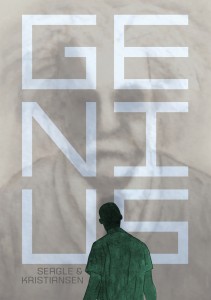
9781596432635Genius
Written by Steven T. Seagle, Illustrated by Teddy Kristiansen
First Second, July 2013
128 pages / $17.99   Buy from First Second or Amazon


“Physics isn’t the most important thing. Love is.”
― Richard Feynman


Ted isn’t a genius. If he ever was a genius, it was when he was a child, skipping two grades, and postulating what the universe is expanding into (“red”). Now, he rides a desk in a cube farm, and his boss (the legendary “Needham”) is tiring of waiting for Ted’s to produce. Ted is an everyman physicist of an unspecified type. Whatever his area of work, it is definitely theoretical; he hasn’t published in years, though not for lack of trying.

It’s not an explicit threat, but Ted is still desperate—not just to save his job and livelihood, but to come up with that “one big idea” that will revolutionize the field, recapture his youthful genius, and allay his self-doubt all in one.

It’s no wonder that he’s having trouble producing anything.

This is not a young man’s game, Genius reminds us, in following with conventional wisdom from A Mathematician’s Apology on down through A Beautiful Mind. It’s certainly not a family man’s game, and most of the times we see Ted sitting down to think, he is interrupted to attend to family matters. At home his teenage son Aron is discovering the joys and horrors of puberty. His wife Hope is waiting for her test results from the doctor. His father-in-law (Frances) is his main foil, delivering barbs that are just as devastating whether he remembers who his son-in-law is or not. But Ted’s last longshot chance is a secret that Frances knows: a secret that Einstein himself told Frances when he was his bodyguard.

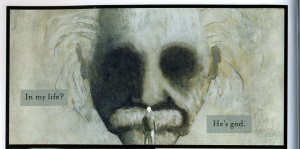
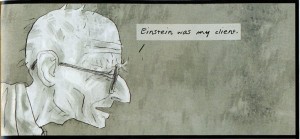
god  client

In Ted’s self-doubt he thinks often of Albert Einstein. The man is his god; he proclaims it straight out. Einstein appears in Ted’s dreams and daydreams—not as the man himself or even a character, but as an avatar of what Ted longs to attain but cannot.

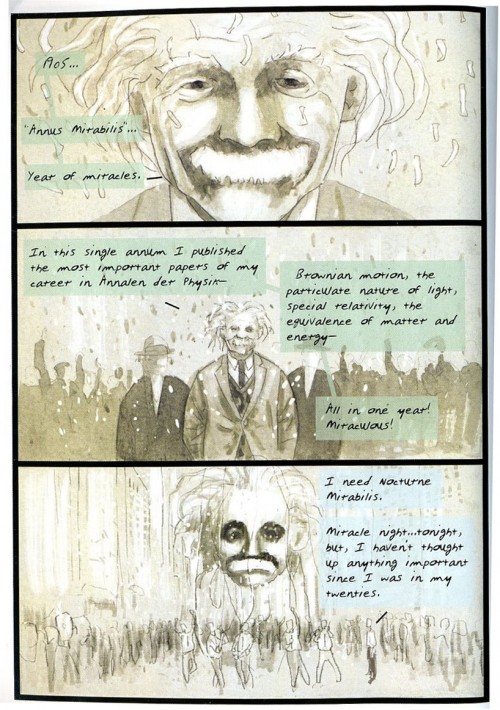
annumGenius makes an idol of Albert Einstein, but this story’s true spiritual deity is Richard Feynman. Einstein is about the whimsy of physics; Oppenheimer is about the tragedy. Feynman on the other hand, is all about the love.
The difficulty in writing a good scientific genius story is in interpreting high level, high concept theory into an emotional narrative without betraying the source material. There are brilliant works of fiction about, for example, theoretical mathematicians. Arcadia is one, and ProofGödel, Escher, Bach is another recent example, a popular nonfiction text that doesn’t pull its punches when it comes to high level science.

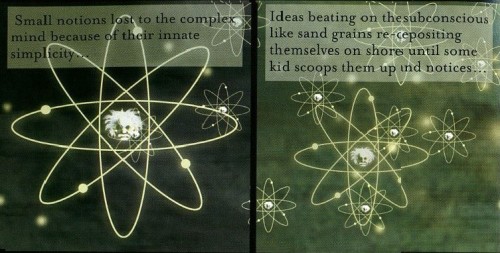
bohrFor all of Genius’s professed love, there is surprisingly little “capital s” Science. The “science” presented here is more a set of symbols and idols. Like the Bohr model atoms pervade the art—a simplified representation of a much more interesting, complex system. Perhaps this is the reason Seagle and Kristiansen focus exclusively on Einstein: the man so synonymous with genius that his name has become a cliché. Everyone can appreciate the meaning of an “Einstein,” even if they have no concept of Newtonian physics, let alone special relativity.

There is a familiar, legitimate emotion to this mindset. Imagine a precocious child in his classroom, bored of the lesson, daydreaming of his idols—Einstein, Edison, Nobel. The scientists in his textbooks are sidebar deities, a portrait and a list of their great achievements. A child has no references for the real-world research process. He doesn’t know anything of the long, hard slog of scientific experimentation or the complex intellectual work of theory. He imagines a secret, held in the minds of the scientists who thought it up.

When Ted has his big realization (as he must) it is represented by grunge watercolor spreads. The spreads do a decent job of graphically representing the feeling of having hit upon a brilliant idea, only to have it slowly fade away as you try to capture it. Often the art has bits of text and scrawled equations to allude to underlying scientific principles.

READ MORE >

Comments Off on Genius
November 25th, 2013 / 12:00 pm

If Not Notley Then Whatley Elseley?

I’m Cassandra Gillig and I can’t believe that it’s Not Illegal to buy this new chapbook by Alice Notley.  It’s not even imprudent or tacky, it’s just a good thing that is good.  I did it two times and am waiting for the results !!!The Results Are In!!! just kidding they’re not I only ordered it seven minutes ago.
No one has gone to the bother of describing the book I have no idea how many pages it is this could be not even a book IS THIS ACTUALLY A BOOK WHAT THE FUCK DID I JUST BUY I AM CALLING THE POLICE if Not A Book then What is It I think probably It is Good do you need more than that? You do?  OK it is this big: 5 1/4″ x 7″.  I don’t remember if quotes mean inches or feet.  Is this a SEVEN FOOT TALL BOOK?  This is just how it has to be when you need it to happen.  I still don’t know if this is a book or not.

Back in the late seventies or early eighties (what) Robert Creeley said of Alice Notley, “She’s the Boss.”  There was even another Boss at that time: Bruce Springsteen.  Alice was just that good; she was better than thunder road or hungry heart–much better.  I can’t believe I know people who have decided to not buy this chapbook I think it’s just rude.  You’re sitting and not buying how should I feel about it if not personally offended.  I am a little sour you have not bought it why are you still reading this and not having this page open to order and buy this chapbook.  This chapbook was made by The Catenary Press which seems like a reliable source of chapbooks.  It seems like–generally–people give them money and then they give those people chapbooks.  It’s so crazy this fucked up capitalist economy where you can buy things or even buy works of art.  What the fuck I miss the good old days when carriage rides were all that moved me.

I can’t review it because I haven’t read it but I can tell you that without Alice Notley’s work I would be probably engaged to be married to The Wrong Guy.  God what would I have done with The Wrong Guy?  Would we have even been able to Go Out?  There’s a  Wrong Guy on almost every corner of every street in every America.  I bet none of them would buy this chapbook.  Oh god what did I almost do???  I am a marked woman through and through.

Random / 4 Comments
November 25th, 2013 / 9:26 am

Author Spotlight & HTMLGIANT Features

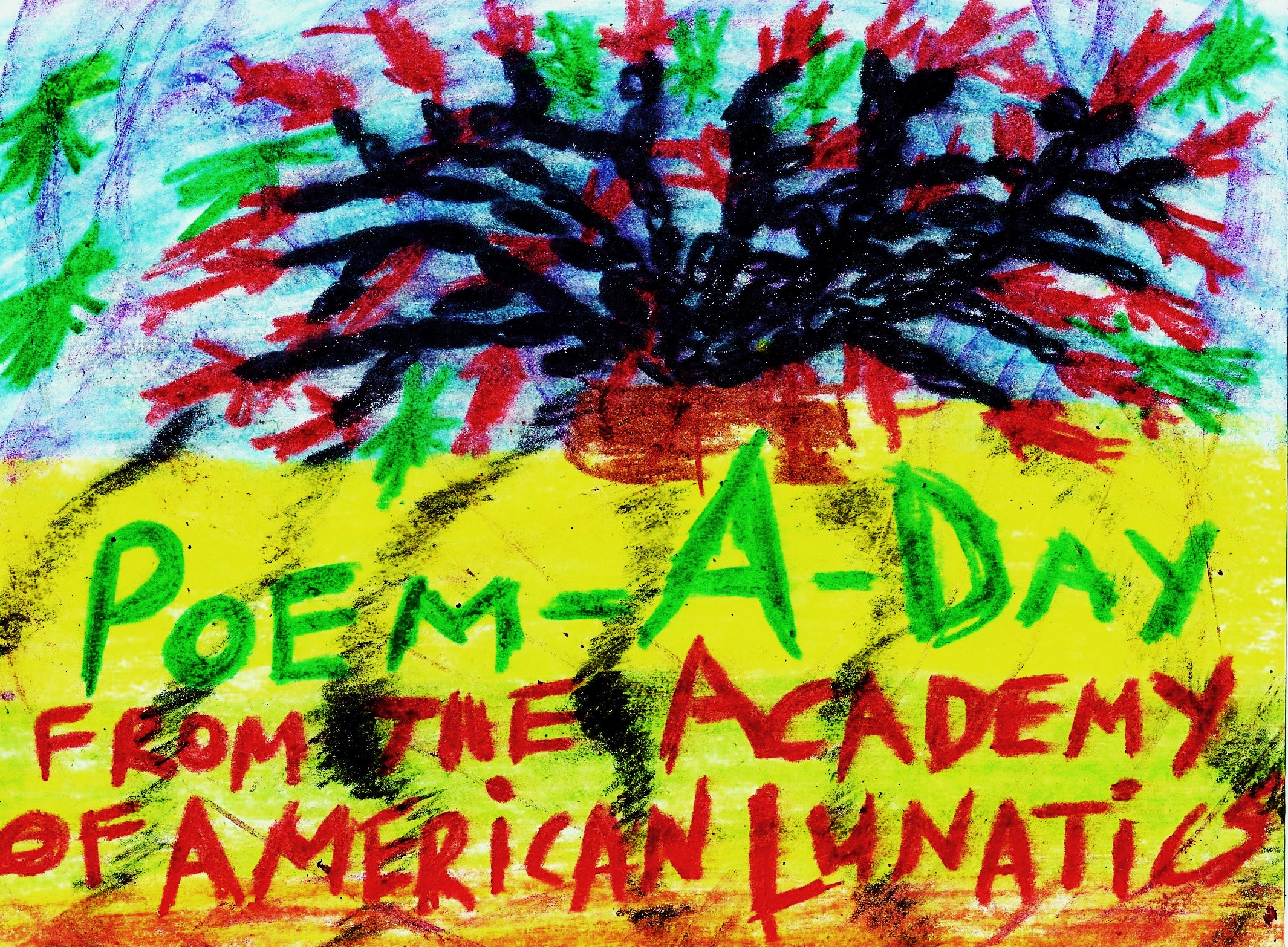
POEM-A-DAY from THE ACADEMY OF AMERICAN LUNATICS (#6)

poem a day danielle 2- copia

danille selfie

Danielle Pafunda resists the day’s terms even as she’s complicit in and bound to them, to carry them out. The children are calling that Playmobil cop Uncle Shootser, again. She’s taking unflattering pictures, no, she means just actual pictures of her navel while she reads Elisabeth Bronfen.

Your Conscript

by Danielle Pafunda


Get the fuck away from me. I’m sick and free.
I’ve puked my heart out and also my other organs.

My liver spills, my kidneys spilled, my blood
turns the color of a nuclear sunset and hums across

the spoiled garden path. I’ve been at these stones
with a shotgun. I’ve been nailing the doors shut.

In any event, I drowned your book in the river.
At the river, two large men grabbed my arms

and pinned me against a shipping container.
They tore your words out of my throat and held them

in the pink arc cast by a security light. Give him up
they told me, and I did. Over and over again

retching into their outstretched sack, retching
money and grief and the look of your hair

plastered down by an oily rain.

poem a day danielle strip
poem a day danielle about this poemWhen I first ate that rat after I first regurgitated that rat (see Johannes) and wouldn’t you know that rat was high on cocaine and babies (see Scientific American January 2006) I had the tongue of a songbird stitched into my tongue (see Chelsea Biondolillo, see Katrina Van Gouw, see Philomela). A blank spot on my tongue. A salt scar on my tongue. I only speak English. I make a high-pitched whinny at which babies coo (see babies). I can identify tone. You have your search terms.

poem a day danielle strip

note: I’ve started this feature up as a kind of homage and alternative (a companion series, if you will) to the incredible work Alex Dimitrov and the rest of the team at the The Academy of American Poets are doing. I mean it’s astonishing how they are able to get masterpieces of such stature out to the masses on an almost daily basis. But, some poems, though formidable in their own right, aren’t quite right for that pantheon. And, so I’m planning on bridging the gap. A kind of complementary series. Enjoy!

poem a day danielle strip

Comments Off on POEM-A-DAY from THE ACADEMY OF AMERICAN LUNATICS (#6)
November 23rd, 2013 / 9:34 pm

“It must be good to run / the show like that.”

If this relationship is going to work—and no one really cares if it does; I mean, ships have jobs; relations are just the second attempt at lations—you’re going to have to accept the fact I’m going to post about some new issue of an online magazine when it rains.

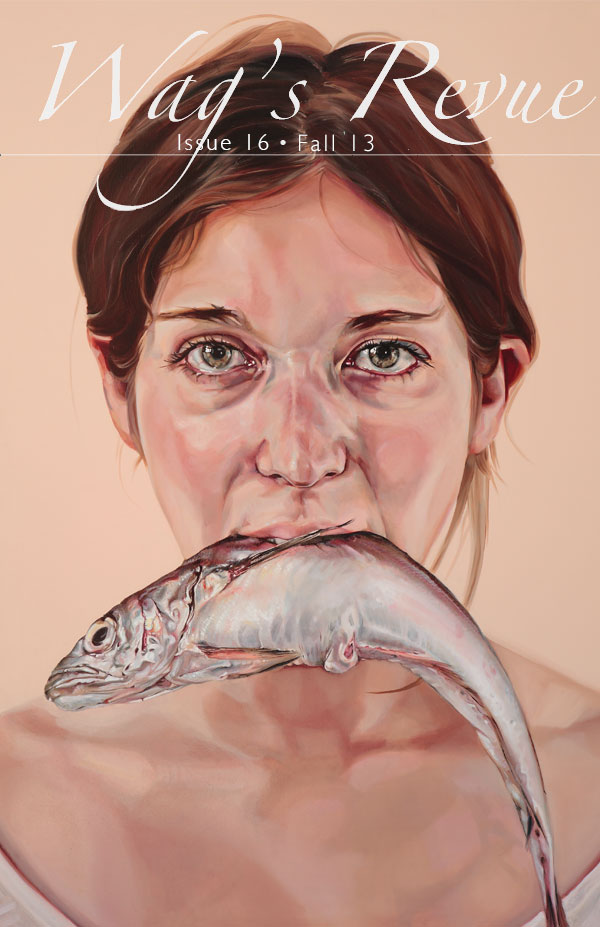
This time around it’s Wag’s Revue, and specifically in Wag’s Revue the rompy and potluck-ish poems of Rachael Katz and the Grace-Paleyish-wise-laughing-at-how-many-generic-varieties-of-Lemon-Pledge-exist-in-our-hearts story called “Palmistry for the Modern Age” by Hannah Pass.

Though I’m not normally a fan of faking book technology online, I think I like the navigation of Wag’s Revue—though I wish the fake-page-box were a little bigger and the font weight wasn’t so extreme. But the editors say they are working on a site redesign, and I am really interested in how declarative the reading experience is. Like it’s very “hark! this is how you shall read.” Which seems against the stream in a way I respect, like when you touch your friend’s antique record player and they snap at you “that’s not for touching!” And you’re like, damn, I respect that.

Respect for yourself by reading Rachael Katz’s “You Girls Are,” which I’m going to go ahead and call the best new ode I’ve read in months of leaves.

Web Hype / 1 Comment
November 22nd, 2013 / 11:58 am

Reviews

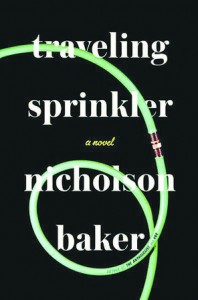
Nicholson Baker’s The Traveling Sprinkler

2021897816The Traveling Sprinkler
by Nicholson Baker
Blue Rider Press, Sept 2013
304 pages / $24.85  Buy from Amazon


Before we begin the review proper, an interesting parallel.

Nicholson Baker, in his 2011 Paris Review interview, on the writing of The Mezzanine: “It was totally absorbing, the feeling of being sunk in the midst of a big, warm, almost unmanageable pond. I could sense all these notes I had, all these observations I’d saved up to use, finally arranging themselves in relation to one other.”

Paul Chowder, Baker’s protagonist in The Traveling Sprinkler, quoting Claude Debussy answering a question about his compositional process: “Gradually after these thoughts have simmered for a certain length of time music begins to centre around them, and I feel that I must give expression to the harmonies which haunt me.”

Chowder, again, quoting Freud, “There are no coincidences.”

We first met the middle-aged poet Paul Chowder in 2010’s The Anthologist, as he attempted to write an introduction to a poetry anthology while navigating myriad distractions, from his lost lady love to the wealth of poetic knowledge residing within his own head. He was Baker by proxy, the writer of dirty books laid bare as an astute intellectual who has money and love problems, copious idiosyncrasies, and who just happens to have a masterful knack for nicknaming male genitalia (“Shropshire lad” being a particularly outstanding one this time around).

For The Anthologist, Baker recorded himself in various locations talking into a camera, attempting to be honest and naked in a way that writers often refuse to be behind the carefully composed written word. Honesty in writing, after all, is always edited, and has the benefit of a first draft.

Similarly, The Traveling Sprinkler, made heavy use of audio recordings, self-interviews, that were later transcribed and tinkered with and embellished into the continued adventures of Paul Chowder, who now finds himself owing a new book of poetry to his faithful publisher, who has now quit drinking Yukon Jack in the meantime, who wants to learn the guitar, who can only seem to write when parked in the shade in his Kia, who has once again lost Roz.

While The Anthologist was very much a book about poetry (well, among other things), this book chronicles our narrator’s love affair with music, from his early years as a promising bassoonist (a career path that was derailed by a basketball accident), to his new obsession with both singer-songwriters and modern dance music. Underworld is namedropped, Debussy’s “The Sunken Cathedral” is dissected in an out, and YouTube URLs to college students singing protest songs awkwardly conclude paragraphs left wanting for proper final punctuation. The only thing missing is an official Traveling Sprinkler Spotify playlist. Excuse me while I make one.

Are there any critics of serious literature remaining that vehemently oppose the appearance of modernisms in novels? If so, poor things, keep them away from The Traveling Sprinkler.

The line between Baker and Chowder is once again thin, if not opaque, but, like the book’s namesake Sears product, winds along in anything but a straight line. It can, admittedly, be distracting, as someone who obsesses over the biographical details of authors, to have to pause and wonder if what you’re reading is really how Nicholson Baker really feels about dance music or drones or climate change or even peanut butter crackers. When we read an obviously fictitious novel, we’re free to get swept away, but with Baker so close under the surface, we want him to be the one talking to us. This may, admittedly, be a hang-up limited to serious enthusiasts, and that particular longing shouldn’t be mistaken for critique.

What Baker has accomplished here is to give us, along with late-period David Markson, the best look into the writer’s brain, one that no Paris Review interview could even begin to reveal. More specifically, the aging writer, the one who no longer voraciously reads, and whose head is full of facts and knowledge, but who faces the very real possibility that the well might be dry and all that is left to do is a sort of self-inventory for posterity. The secret is, of course, that writers of all ages are doing just that, perhaps dressed up in a grand narrative or imaginative forms, but that nonetheless. Just ask the 31-year-old that wrote The Mezzanine.

The parallel with Markson is an interesting one, as Paul Chowder admits to never having been able to read novels, while Markson admitted (both in interviews and later by way of his own thinly guised fictional protagonist) to having run out of drive to read them, and that with five of his own still to come. Both writers eventually stumbled upon a groove in which they became literal anthologists of the contents of their minds, Markson right up until he died.

In an all-to-brief and somewhat stilted interview on The Colbert Report, Baker likened the traveling sprinkler to us, navigating the garden of our minds. I’m not sure there exists a more perfect, if idiosyncratic, metaphor for writing, although what force it is that pulls us along is still up for debate. Regardless of your answer, it’s worth celebrating that Nicholson Baker still has plenty of hose left.

***

James J. Fitze is a writer and editor living in New York City. A music journalist “in a past life,” James currently contributes to a living novel at thedownmachine.com.

1 Comment
November 22nd, 2013 / 11:00 am

Reviews

The Fata Morgana Books by Jonathan Littell

fata-morgana-coverThe Fata Morgana Books
by Jonathan Littell
Translated by Charlotte Mandell
Two Lines Press, Nov 2013
208 pages / $14.95  Buy from Two Lines Press or Amazon


The four novellas that comprise this collection deal with a wealth of themes, but the ultimate one is of unachieved desire and the isolating mania it spawns. Instead of the narrators (or perhaps they’re all the same person in each story) dealing with crushing let downs internally, the reality surrounding them alters into hellish distortions of traverses through time and space. ‘Surrealistic’ doesn’t fully capture the formal breed of this collection, but each reader still gets pressured into a position of abstract meaning-making. Each first-person protagonist comes across as calm, numb, accepting, and apathetic toward the edge of reality they skate on through these sparse stories. From one novella to another, though, a sense of personal progression exists through the environments the narrators find themselves in. Yet each setting is coated with a muffled insistence on the pointlessness of these progressions.

The first novella, Etudes, is a solitary study of man unafraid of the warzone he’s captured in, yet terrified of acting on his desires toward his woman of interest. These unmet desires move the narrator to more accessible perversions, which morph playful and genuine aspects of interaction into ones of horror. The objects of his affection alternate through the four sections of this story, but his own timidity of intimacy begins to create external barriers that increasingly prevent him from even being in the presence of the woman he wants. “My despondency was so profound that I was only barely aware of the appalling comedy of the situation,” he recounts after a flight delay makes it impossible to share a plane ride with his current obsession. The final section, however, shows the narrator as an emotionally sapped and mechanical being, going through motions that prevent him from fully dealing with his past failures.

Story About Nothing is a free flowing narration of negation. Its dreamlike uncertainty weaves through the inner sensual life of a man who defies his masculinity by wearing women’s clothing beneath his socially accepted guise. Human motion plays a large role in this story, from his description of pornography that paralyzes his eyes and attention in awe (“these images remained what they were, frozen in the eternal repetition of their so violently human perfection”) to the motions of dancing women, and the process of his drunkenness alike as “a form of communion, the step beyond that imperceptibly opens up the road to the world of death, revealing to the one taking it that it already stretches far behind him, and always has.” In the end, it’s a sweet story about bitter life, contradicting itself into nothingness.

The two stories previous to In Quarters had narrators with a sense of character, while the latter two increase the numbness and alienation. In Etudes, characters had letter names (A., B., C., etc.); in this third story, a dismissive identification—as if all children and all adults were some abstract conglomeration of otherness—is all that exists:

As for me, I watched these people around me, I watched them attentively, but they remained out of my reach, like an image seen through a glass pane; even if I pressed my face against it, it was impossible to pass beyond it, to break this invisible surface or, on the contrary, to plunge into it as into an expanse of cold water; and behind it, things, equal themselves, arranged themselves in a great mute tranquility, a harmonious design of colors, light, and movements, which organized into one single peaceful but inaccessible image blonde child, sleeping cat, chatting women, and the young girl with a peach.

Isolation engulfs the narrator here as a permanent fact of life. No joy can be experienced like the playing and laughing children that form the background of a scene, only the annoyance of their interrupting his reading. The images that float before him begin to meld despite their disharmony, going from a soldier chopping off a prisoner’s head to a naked girl brushing her teeth right in front of him completely seamlessly. In abstraction his isolation grows stronger. Through symbolic Adam and Eve interpretations he starts to instinctually distance himself even further from the woman who wants closeness with him, and the comfortable family life he’s surrounded by seems only a loosely guarded microcosm with ready potential for fear to penetrate and crumble it.

The last and longest story, An Old Story, begins with our narrator emerging from the water, like the progression of narrators throughout all of these stories ascending to the numb surface of isolated reality from their past dawdlings beneath, in their own interior full of fearful romanticizings. The deeper into this collection of stories we go, the less frequently paragraphs breaks exist, and by this final story all of life becomes something akin to a no-rest endurance test. Different permutations of fucking and being fucked get explored through these large blocks of text, along with tilting perspectives on dominance, submissiveness, masculinity, and femininity. Any sense of normal life begins to dissolve once we enter into a hallucinatory orgy scene, where, in the grip of complete unreality, terror immediately pervades. By enacting his own perversions into active reality, our narrator leaps from simple indulgence to becoming a prisoner of his own imaginative desires yet again, and jumps back into the water. When he comes back up in the second section, all of life still seems foreign to him, like someone else’s imagination in action. Former memories get mixed up and forgotten as he cuts apart figures in photographs, rearranges them, and tucks them away in the confines of his pocket. A prostitute who he frequented, but couldn’t remember, beats him up and eventually he trips into an underground gay sex club that turns into his own personal army, an army that eventually wanders around raping and pillaging. Any remaining desires of equality and comfort get fully eradicated by our narrator as he continues to move forward and finally accepts that all of life is eternal conflict.

4 Comments
November 22nd, 2013 / 11:00 am

NEKKID & NEUROTIC

Interesting piece on the Romantik of the 70s. Reference-heavy, but mostly familiar texts & media, I think.

Also, click on the second footnote’s link to read the Eno thing: Naked and Neurotic. It’s kinda wild/ weird: “The only time my feet aren’t cold is when I make love, which I do all the time. I only make love to keep my feet warm.”

Random / 1 Comment
November 22nd, 2013 / 2:58 am

Author Spotlight & Behind the Scenes & HTMLGIANT Features

“Why The Hell Wouldn’t I?”– (Talking to Evan J. Peterson)

evan2

Rauan: When we chatted in person you mentioned that a big part of your outrageous onstage persona is a pushback against over-serious readers (performers of their own poetry, I mean) who, as you said, have absolute “no sense of humor.” Can you talk a bit more about these “serious” readers and your more “fun” and outrageous style then as a kind of antidote?

Evan: Poets are often outrageously arrogant and self-important, blaming readers if they don’t enjoy the work. What a cop-out. That grave delivery of words from a podium: is it any wonder most people don’t read poetry? I prefer poetic rock stars (though they can be just as arrogant). I’d rather be humble in person and outrageous during readings. I maintain that level of performance and spectacle to give the audience a multi-sensory experience. I want them to leave feeling gratified that they came to see it, hear it, not just read it. I want them to see costumes, hear me sing the disturbing pop lyrics I’ve brought attention to on the page, and occasionally eat whatever curious thing I set out for them.

RK: your books (The Midnight Channel and Skin Job) are filled with monsters and slasher film victims (final girls, or in a few instances, boys) but for me what stands out most is an experience and atmosphere of exuberance and glee. Are the books, then, just like yr reading performances, meant to be “fun” also??

EJP: Yes, absolutely! I feel that if I had fun writing a piece, many readers will have that fun reading it. Without an element of camp and glee, poetry (especially work as dark as mine) quickly becomes an exercise in despair, punishing the audience. I do love Sylvia Plath’s bombastic technicolor despair, but I don’t want to be an icy, detached poet, that arrogant “fuck you, dear reader” poet. I hate that guy. I want my reader to tap-dance with me through the haunted children’s hospital.

READ MORE >

1 Comment
November 20th, 2013 / 6:29 pm