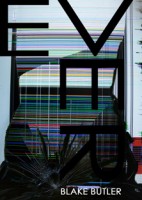
 The narrative constraints of Ever – presumably a woman inside a room; that’s it – is a precarious way to write a novella. Without characters, plot arcs, locations, etc., language itself is summoned as a surrogate protagonist. The writer – thus reader – are both stripped of the typical arsenal of fiction; what is left is simply language’s ability to summon or evoke the most intrinsic visceral ‘truths’ of being alive, a collection of nerves funneled into a consciousness.
And that is, at heart, what Blake Butler’s Ever is about, a kind of timeless consciousness that is, remarkably and/or ironically, very relevant to a particular time: now – dispersed with cryptic evocations of some post-apocalyptic world, as in “[…] not that we knew the moon here anymore […]” Notice that Butler chooses the word ‘knew’ instead of the more likely ‘saw’ or ‘had.’ This suggests either a cognizant or intuitive decision to focus more on perception than facts.
 One of my long-time favorite media-blogs

 I can still remember with odd clarity the first time I read the words of