Kafka

The Higgs-Jameson Experimental Fiction Debate, part 1
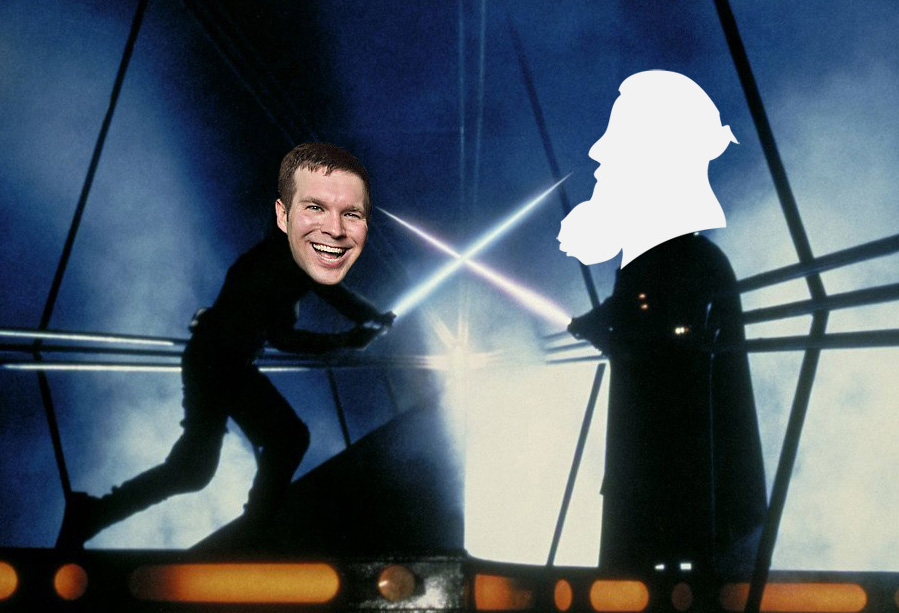
 

A D Skywalker vs. Darth Higgs

Adam: Last weekend, playing a stray note on my recorder summoned a cyclone that whirled me away to the swamps of Tallahassee. There I impinged on Christopher Higgs and his wife, who lodged me in their spacious Rococo flat (refurbished from a gator-packing warehouse). Over dinner, Chris and I had numerous opportunities to discuss—and to disagree about—the nature of experimental fiction…

A D JAMESON [leaning back from his seventh helping of tiramisu]: At the risk of spoiling such a fine meal, perhaps you and I can finally figure out why we’ve butted been butting heads regarding the nature of experimental fiction.

CHRISTOPHER HIGGS: OK.

ADJ: Let’s start by each defining what we think experimental fiction is!
READ MORE >

Craft Notes / 47 Comments
February 27th, 2012 / 8:01 am

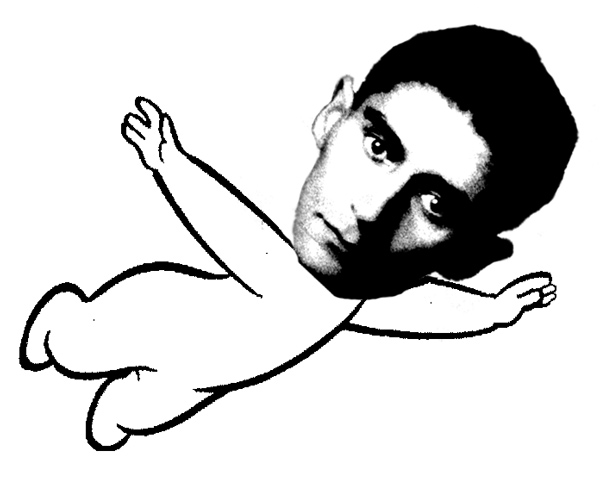
kafka the friendly ghost

do you talk to dead writers?

i do.

READ MORE >

Craft Notes & Massive People & Random / 9 Comments
September 30th, 2011 / 5:09 pm

The Poetics of Non-Arrival: KAFKA

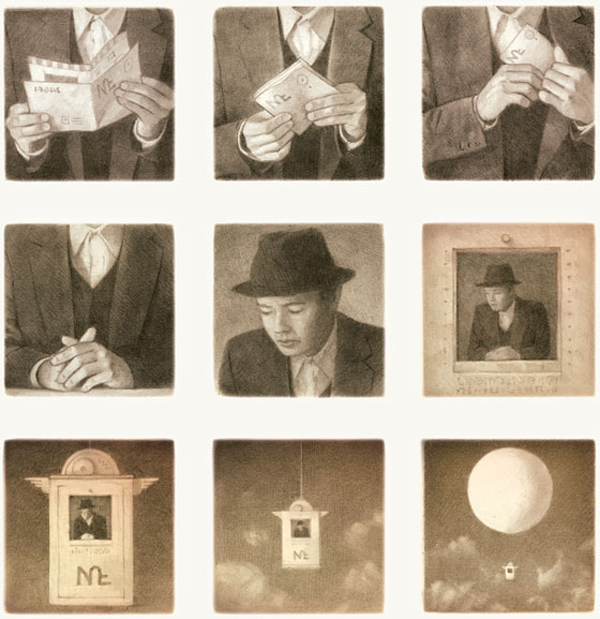
Illustration by Shaun Tan

“Am I a circus rider on two horses? Alas, I am no rider, but lie prostrate on the ground.”
–Franz Kafka in a letter to Felice Bauer, 1916

He was talking about the Jewish horse and the German horse
(But there is also the Czech horse.)
What horse did Kafka ride?
Where does Kafka belong?
Who owns Kafka? *

These sentences kill me.
Imagine: prostrate on the ground.
That’s what an exilic existence is like
Prostrate on the ground.
Living in the place that is no place
Riding the no horse
Going nowhere, only not-here
With no language
Never quite comfortable in any language. **

When the narrator in the story “My Destination” is asked where he is going
He says,

“I don’t know.”

“Away from here, away from here.”

“Always away from here, only by doing so can I reach my destination.”

Always away, never arriving. ***
Butler: “…the monstrous and infinite distance between departure and arrival….”

Kafka: “For it is, fortunately, a truly immense journey.”

.

.

.

NOTES
* [I love this essay about Kafka by Judith Butler.]

** [Butler: “We find in Kafka’s correspondence with his lover Felice Bauer, who was from Berlin, that she is constantly correcting his German, suggesting that he is not fully at home in this second language. And his later lover, Milena Jesenská, who was also the translator of his works into Czech, is constantly teaching him Czech phrases he neither knows how to spell nor to pronounce, suggesting that Czech, too, is also something of a second language. In 1911, he is going to the Yiddish theatre and understanding what is said, but Yiddish is not a language he encounters very often in his family or his daily life; it remains an import from the east that is compelling and strange. So is there a first language here?”]

*** [Kafka: “Written kisses don’t reach their destination, rather they are drunk on the way by the ghosts.”]
Behind the Scenes & Craft Notes & Massive People & Random / 1 Comment
April 6th, 2011 / 7:52 pm

I would like to hear optimistic statements about the writing life.

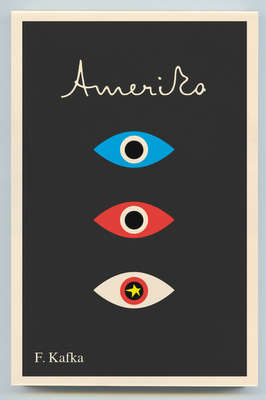
Mendelsund on Kafka

More great covers and Peter’s thoughts on the redesign.

Behind the Scenes / 5 Comments
January 28th, 2011 / 3:37 am

Speaking of Anne Carson,

which we were doing at some point in the last 10 or so posts, there’s a prose poem of hers from Plainwater that makes me want to die.

On Waterproofing

Franz Kafka was Jewish. He had a sister, Ottla, Jewish. Ottla married a jurist, Josef David, not Jewish. When the Nuremburg Laws were introduced to Bohemia-Moravia in 1942, quiet Ottla suggested to Josef David that they divorce. He at first refused. She spoke about sleep shapes and property and their two daughters and a rational approach. She did not mention, because she did not yet know the word, Auschwitz, where she would die in October 1943. After putting the apartment in order she packed a rucksack and was given a good shoeshine by Josef David. He applied a coat of grease. Now they are waterproof, he said.

Excerpts & Random / 10 Comments
January 27th, 2011 / 8:31 pm

HTMLGIANT Features

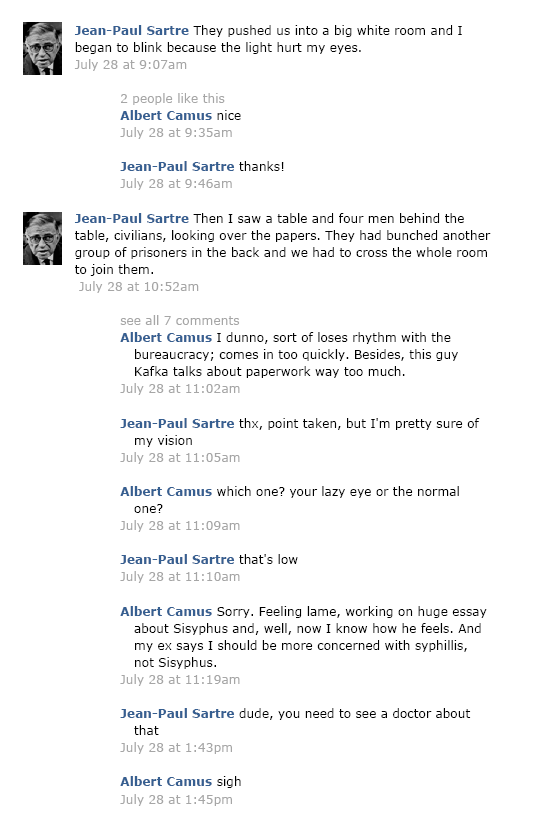
Sartre publishes “The Wall” on his facebook wall
READ MORE >

53 Comments
September 7th, 2010 / 6:23 pm

On Chaplin on Kafka on Red Dead Redemption on
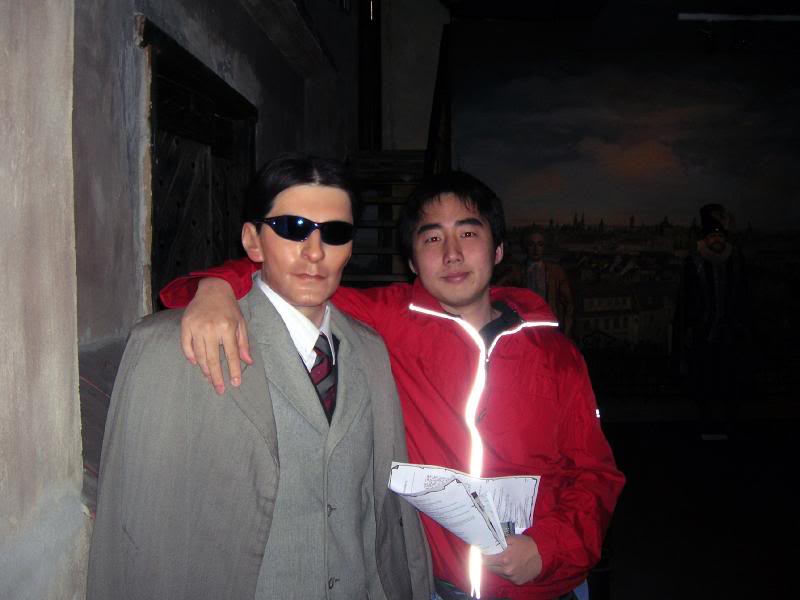
“The Wish to be a Red Indian”
by Franz Kafka
Trans. by Willa and Edwin Muir

If one were only an Indian, instantly alert, and on a racing horse, leaning against the wind, kept on quivering jerkily over the quivering ground, until one shed one’s spurs, for there needed no spurs, threw away the reins, for there needed no reins, and hardly saw that the land before one was smoothly shorn heath when horse’s neck and head would be already gone.

READ MORE >

Author News & Film & Web Hype / 6 Comments
August 26th, 2010 / 3:54 am

Power Quote: Kafka on writing

“It is, in fact, an intercourse with ghosts, and not only with the ghost of the recipient but also with one’s own ghost which develops between the lines of the letter one is writing and even more so in a series of letters where one letter corroborates the other and can refer to it as a witness.”

Franz Kafka, from a letter to Milena

I suspect by “letters” he means, generically, the written word, though he could also be referring to letters, the medium with which he is writing to Milena — or, and this is my fancy, he could mean the letters which make up words themselves, thus dramatically altering exactly what is “[in]between the lines” and their respective “corroborations,” a funny yet telling invocation which hints at some complicity, as if writing is a shameful lie. His “intercourse with ghosts,” short of necrophilia, simply tells of a man who replaced love with words. (One should see desire in the pulp of paper.) Think about Kafka long enough, and you enter a dark tunnel. Don’t think about him, and your world too perfect, untouched.

Power Quote / 8 Comments
February 18th, 2010 / 12:52 pm

A cage went in search of a bird

February 23. Unwritten letter.


–Kafka, The Blue Octavo Notebooks (Fourth Notebook)

Excerpts / 10 Comments
May 22nd, 2009 / 6:05 pm

Anarchism as the Source Decay of Royalism

They were given the choice of becoming kings or the kings’ messengers. As is the way with children, they all wanted to be messengers. That is why there are only messengers, racing through the world and, since there are no kings, calling out to each other the messages that have now become meaningless. They would gladly put an end to their miserable life, but they do not dare to do so because of their oath of loyalty.

–Kafka, Blue Octavo Notebooks (Third Notebook)

Uncategorized / 28 Comments
May 20th, 2009 / 4:25 pm

Myths of History / Histories of Myths, with your host, Franz Kafka

The history of the world, as it is writen and handed down by word of mouth, often fails us completely; but man’s intuitive capacity, though it often misleads, does lead, does not ever abandon one. And so, for instance, the tradition of the seven wonders of the world has always had associated with it the rumor that there was another, an eight wonder of the world, and concerning this eighth wonder there were various, perhaps contradictory, statements made, the vagueness of which was explained by the obscurity of ancient times.

The Blue Octavo Notebooks (Second Notebook)

Author Spotlight & Excerpts / 2 Comments
May 17th, 2009 / 10:37 am

Something Baffling, Something Bloom: In which I follow H.B.’s advice and start reading Kafka’s Blue Octavo Notebooks

February 19, 1917.

Today read Hermann und Dorothea, passages from Richter’s Memoirs, looked at pictures by him, and finally read a scene from Hauptmann’s Griselda. For the brief span of the next hour am a different person. True, all prospects as misty as ever, but pictures in the mist now different. The man in heavy boots I have put on today for the first time (they were originally intended for military service) is a different person.

–The First Notebook

Uncategorized / 14 Comments
May 14th, 2009 / 4:12 pm

Power Quote: One of Harold Bloom’s Hands Clapping Edition

This one’s for my homies who asked for a more detailed commentary on Dickens/Bloom that I don’t have time to offer up this week.

One of the blessings of Dickens’s powerful influence on Kafka is the altogether Borgesian impact of Kafka on our understanding of Dickens.

- The Western Canon, “The Canonical Novel: Dickens’s Bleak House and George Eliot’s Middlemarch

Power Quote / 6 Comments
May 6th, 2009 / 1:32 pm

checking back in with Joshua Cohen and Kafka’s Office Writings

I’m sure you’ve all been keeping up this week with Nextbook.org’s five part series on Kafka’s Office Writings, which I first blogged about on Monday. But in case you haven’t, this is a good time to look over what you’ve missed so you can be all caught up for the big (?) finale tomorrow. The series, as I’ve mentioned now several times, is authored by Joshua Cohen, quite possibly the youngest working critic to be described non-ironically as “venerable,” assuming he has ever actually been called that before, which, if he hasn’t–well he has now.

(clicking anywhere on the text of a given day takes you to that day on Nextbook)

Today (day 4) we’re learning about Kafka and Nazis:        >>It has become a commonplace to say that Kafka’s work prefigured, in image, or predicted, in word, the horrors of Nazism. That argument is most often advanced by a litany of external congruencies between Kafka’s fictional world and the Third Reich: bureaucracy (though the Nazis were always more efficient than the authorial imagination), the infringement of technology on daily life, random violence, unappealable official destinies, fates based on birth, etc. Kafka’s intuition of Nazism was far more personal, however, far more inwardly directed. It can be found in his characters’ desires to join something, to become part of something, whether a style or form of being, or even a Volk (which, in Kafka’s case, would have, perversely, been Judaism).<<

+

Yesterday, we learned about how Kafka’s work directly inspired his art:          >>While no intro1duction of “cylindrical shafts” could overturn such a metaphysical damnation, there is no doubt that the image of a body inscribed by technology springs from Kafka’s arbitrating experience with traumatized workers.<<

+

On day 2, we learned about the history of office life in Europe:           >>[Kafka's] origins lie before industry certainly, before widespread centralization. He began, in fact, when people stopped working for themselves and started working for others; when individual or familial subsistence gave way to earning a living. Work, in the 19th century, became largely an indoor activity, making daily labor—not in the fields and farmlands, but behind four walls in a plant—seem contained, a place where behavior could be scrutinized, and surveilled.<<

+

And back on day 1 we got an overview of Kafka, and of what the rest of the week was going to be like:     >>Franz Kafka wrote as insurance against suffering the fates of his characters. It was as if every hour he spent writing, by candlelight and, later, by electric light, was an installment paid against darkness. He knew that with a stroke of the pen he could conceivably, at any time, have restored to Joseph K. his easy life before The Trial, and obtained for land surveyor K. a better position with a gentler Castle. But this is what makes Kafka the great writer of what has been called Modernity: That he stayed true to his fictions, and retained their tragedy.<<

+

After you’ve had your fill of nonfiction, consider perhaps some of his other literature. Cohen is the author of five fine books out from presses that Giant readers and contributors alike have deep affection for: A Heaven of Others (Starcherone, 2008), Two Tribal Stories (Small Anchor, 2007), Aleph-Bet: An Alphabet for the Perplexed (Six Gallery, 2007), Cadenza for the Schneiderman Violin Concerto (Fugue State, 2007), The Quorum (Twisted Spoon, 2005).  A new novel, Graven Imaginings, is forthcoming from Dalkey Archive.  Better get on over to his website and see what the score is.

Author Spotlight / 8 Comments
December 4th, 2008 / 1:51 pm

ALL THIS WEEK: Sympathy for the Cubicle Rat at Nextbook.org, starring Franz Kafka and Joshua Cohen

not Joshua Cohen. Or Kafka.

 >>This event—finally, the translation and publication of the last known scrap of Kafka’s work left untranslated, and unpublished—brings us to the subject of this series: how Kafka’s office writings influenced his fiction, and what that influence means. Kafka’s office writings, as presented here, cannot be read on their own (they are incomprehensibly boring) but, instead, must be read as companions, to demystify the three novels and stories (which are anything but boring). Taken together, though, both workaday fact and masterwork fiction create a network of connections that exposes not just the concerns of a single writer, but also that of a singular culture — the culture of the Office, which has imposed itself on what used to be our lives. <<

Check back at Nextbook.org every day this week for a new installment of Joshua Cohen’s writing about Kafka’s Office Writings. Also, there may be periodic updates here, highlighting our favorite pieces from the series and/or reminding you to go read it. 

Who could say no to this mug?


Or this bug?

Or this bug?

Author Spotlight / 4 Comments
December 1st, 2008 / 5:09 pm