Frank. Yes, he’s that, ribald but also delicate—a reactionary event if only for being born. He’s the subject of CAConrad’s The Book of Frank, first published by Chax Press and freshly picked up by Wave Books, who have padded it with additional poems and a glowing Afterword by Eileen Myles. Despite steady output from Conrad, the book’s creation took over a decade.
These are not persona poems, but I’m still curious about the distance between the repressed, ever-morphing Frank, and the poet, so easy in his skin, disarming. I saw CAContrad reading at St. Mark’s Poetry Project this fall: there’s the characteristic nail polish, glittery and red; a wooden Chinese fan sways from his fingers. As he begins, a gladiola leaning against the podium begins to fall. But Conrad catches it. “This is a very unruly gladiola,” he adds, moving on to the next poem with the bloomy staff clasped in hand.
What’s your reading cessation policy for any given book, if you have one? Is it “I’m going to give this until page 25/75/150 and if I still don’t like it…”? Does anyone “slog through” books anymore, or is “life too short”?
And, although I’m sure we’ve asked before, has the internet affected your readerly stamina? Expectations?
I associate the “endure-it posture,” let’s call it–I will finish this book because I started it and because it’s an ‘important’ book for such-and-such reasons or because so-and-so adores it–with a younger self, a self I sometimes miss because she was more disciplined in certain regards than I am now. It’s also the posture, often, of the student, an entity that I am no longer. I withstood a lot of D.H. Lawrence when I really wanted to be reading Beckett in the bathtub.
I’ll say now: I read until I stop caring. But that’s a loaded statement. Has my care threshold been eroded? I’m really still mostly interested in my original question, and I don’t want this little thing to ooze into issues of what we like/don’t in a work , etc…but I’m wondering, tangentially at least, about our stop-and-go signals, and how they might be peer- or culturally influenced.
UPDATE: Qaeda Quality Question Quickly Quickly Quiet came from Wag’s Review #7. Check out the rest of the issue (including an interview with HTML Giant patron saint Gary Lutz!) here.
THE WORDS TO EVERY SONG: Band Tattoos from Music Lovers Worldwide, edited by Eva Talmadge
IT’S ANOTHER CALL FOR SUBMISSIONS! As with THE WORD MADE FLESH, edited by Justin Taylor and yours truly and launched from this very blog last summer, here’s another announcement for a tattoo book. This time around we (the royal we; I’m doing this as a solo project while Justin devotes his time to writing) want to see your band tattoos. Song lyrics, band logos, record labels, musician portraits, you name it. If you’ve ever loved a song or a musician or a band so much you went to the tattoo shop and made your devotion permanent, we want to see it.
I wanted to write about this, or at least mention it here, because it’s occupying my mind to the point where I feel guilty for spending two hours recording videos of myself singing songs by Ke$ha , watching a shitty horror movie, or even listening to stoner metal last night. Hell, basically the fact that I did anything other than “be angry” is making me feel guilty. But on the other hand I know that’s ridiculous, and that the unfortunate fact of the matter is being angry wouldn’t have accomplished anything. To be fair nothing I actually did accomplished anything either. I don’t know what I could have done that would have been helpful, so I guess getting the information out to people who don’t know is something I can do at least.
The above video is a 4 minute and 11 second excerpt from David Wojnarowicz’s experimental film Fire in My Belly. This is all I’ve seen of the film (in fact I didn’t even know that this was only an excerpt, as opposed to the entire film, until yesterday), but I’ve watched it a lot. Wojnarowicz is an artist that I find really powerful, both from the entire scope of his life story and in the art he produced itself.
By 16, Wojnarowicz had dropped out of high school and was living on the streets, due to a shitty home life and the terror he faced due to his own homosexuality. Homeless, he hustled for a living, eventually hitchhiking cross-country a few times before settling in NYC in the late 70s. In the 1980s he was diagnosed with AIDS.
Not to pull attention away from his earlier works–virtually everything he made throughout his visible life as an artist is amazing–but the work he started to make after being diagnosed, well, the work was angry. David Wojnarowicz was angry because he was invisible–because queers were invisible. Something that he said, that I think is really fucking just so to the point, is what follows:
”I want to throw up because we’re supposed to quietly and politely make house in this killing machine called America and pay taxes to support our own slow murder and I’m amazed we’re not running amok in the streets, and that we can still be capable of gestures of loving after lifetimes of all this.”
At Montevidayo, Megan Milks wrote about Anna Joy Springer’s The Birdwisher from Birds of Lace Press. She received The Birdwisher from her HTMLGIANT Secret Santa last year. If you haven’t signed up yet, you have less than two weeks to make sure you get a cool gift like Megan did.

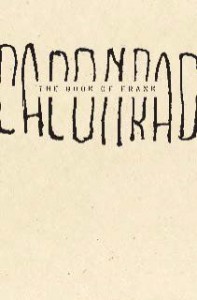 Frank. Yes, he’s that, ribald but also delicate—a reactionary event if only for being born. He’s the subject of CAConrad’s The Book of Frank, first published by Chax Press and freshly picked up by Wave Books, who have padded it with additional poems and a glowing Afterword by Eileen Myles. Despite steady output from Conrad, the book’s creation took over a decade.
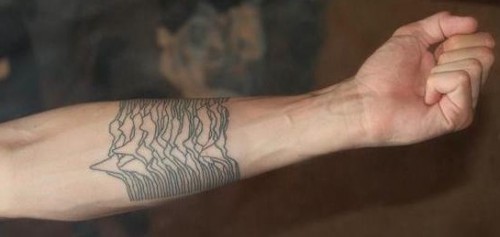 THE WORDS TO EVERY SONG: Band Tattoos from Music Lovers Worldwide, edited by Eva Talmadge
 At Montevidayo, Megan Milks wrote about Anna Joy Springer’s The Birdwisher from