
 I imagine that I’m not the only one that carries around up to half a dozen books with them everywhere they go, at all times. I really hate having any kind of down time with nothing to read. Doctor’s office, in line at Walgreens, on my way to sell books at the Strand, less exciting moments in foreign movies I’m watching, or for when my lady friend is watching Top Chef. Whatever. One of the few I was lugging along on the train today—Crossing to Safety by Wallace Stegner (which is pretty great so far, fyi)—had an interesting passage that got me to thinking about the previously unconsidered victims of my solipsistic and obsessive habits.
“You must have brought something. Books? I never saw you without a green bag of books.” To her mother she says, “He reads everywhere—in the subway, between the acts at plays, at intermissions in Symphony Hall, on picnics, on dates.”
This speech conveys considerable information to Aunt Emily. She watches Sid’s eyes close in mock agony, while a really very engaging smile takes over from the sheepishness on his face. “Well, there’s so much to read, and I’m so far behind. Everybody’s read ten times more than I have.”
“What did you bring?” Charity asks. “Restoration dramas?”
“I’m taking a rest from those. I’ve just got some hole-fillers. Middlemarch, The Idiot, things like that, novels I should have read but haven’t.”
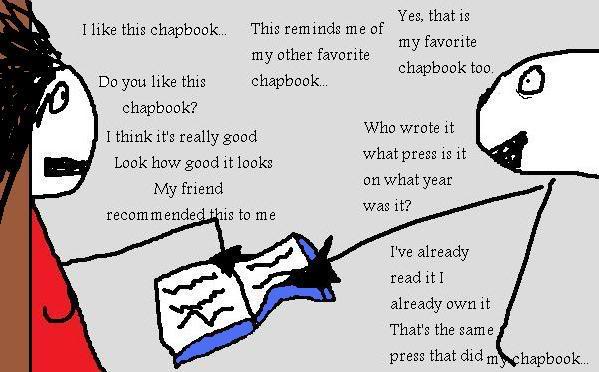
When is it okay to bring along books, and when is it not? Dinner parties? The bar? Bar Mitzvahs? Sporting events? Sporting events where your team sucks and them losing is a foregone conclusion but you still want to tacitly show your admittedly wavering support? Please advise.




 going to write well, the mind turns turtle. Out comes the person at the typewriter, the writer, whom I do not carry away from the typewriter. I talk about writing with other writers in this sort of desultory manner but I’m not really eager to do it. So there is that thing that belongs to the typewriter and the piece of paper. This turning turtle occurs, but as Forster says in his lecture, this one can also produce gibberish. This element of mystery is there for me. I’m not very articulate about writing, as you can see. If I could sit here and tell you everything that happens and why I do it—aside from a compulsion and an absolute love for writing, I don’t think I’d write. I don’t think I’d do it all because it’s a lonesome thing. When I start a new book I feel as though I’m going into a cave that I can’t come out of until the book is finished. I have a routine of getting to bed early and then getting up early so that I’m at the typewriter by no later than seven. It’s very lonesome, and nobody is really willing to share while you’re going along and writing.
  I can tell you why anything in my books is there and why something happened, but aside from that, I probably can talk about somebody else’s writing better than I can my own. When a work is finished, I can talk with you about it, every section and every word, but that is when it’s finished. At the time I am writing, I can’t talk because the process is not known to me. For me, the writing is enough. I don’t need to discuss it. When I write, I want to look at something as closely as I can. I have old notes stuck in my journal. One of them is very old now, it’s from about 1968, and it says, “Examine the essence of shunning.” That interested me at the time, and some day I might write about it. But that’s the way it comes about; I said that I want to look at that as closely as I can.
