
 Wonderfully lucid and idea-rich post by AD Jameson at Big Other: Alternative Values in Small Press Culture. This is one for bookmarking. Jameson looks at three values that small press culture inherits somewhat lazily, Jameson claims, from culture-at-large: celebrity, youth, and money. Then he says: “What values might replace these? What else could writers and presses be prioritizing, and pursuing? And what would that look like?” In answering these questions, Jameson throws out a ton of practical and exciting suggestions. Cool stuff.
Identity Loss
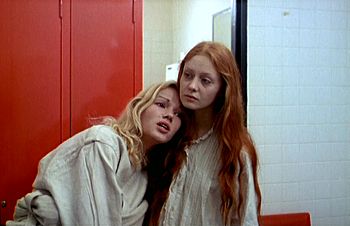
(This is another short reaction to the films in this list. I have now had a chance to see 13 of the 50. When Blake first posted to the list, I had seen four. The first two on the list are on my nightstand. A few others I have found at Seattle’s Scarecrow Video. Some are proving very difficult. Any help procuring the Dore O movie Alaska would be appreciated.)
Another recurring theme from the films on the list is that of identity loss. A film from the last post (Cure) and a film I watched a few days ago (The Night of the Hunted) both had contrasting kinds of identity loss.
Here’s John Clute’s The Darkening Garden: A Short Lexicon of Horror on the subject:
In horror…[Identity Loss] works as a confirmation of the self’s purchase on the present tense of the daylit daily world; it is a marker of Belatedness made visible or to come; it is a signal that the abandoned past (over the last two centuries, most of our pasts have been abandoned) is catching up with us.
Cure’s antagonist has rejected his own identity. When questioned (by those who attempt to help him when they find him wandering aimlessly, by the police who suspect him of murder), he claims no memory of anything. He claims to make few new memories, asking his inquisitors their identities even after they have introduced themselves and never being sure just where it is he is. He claims that all the things that were once within him are now on the outside; that he is a shell.
READ MORE >
Are we really all reviewers?
Here’s a cool new thing if you’ve got the cash to spare: The Rumpus has started up a book club in which you’ll be sent an advance copy of some anticipated novel each month in exchange for twenty-five dollars. At the end of that month you’ll be invited to “a moderated online discussion” with the author.
“It used to be that only people in the media got advance copies of books but that wall has come down quite a bit. Now everybody’s a reviewer.”
Really? Are we all reviewers now?
Thomas Jefferson, make up your mind

“We will be soldiers, so our sons may be farmers, so their sons may be artists.”
— Thomas Jefferson
“The tree of liberty must be refreshed from time to time with the blood of patriots and tyrants.”
— Thomas Jefferson
Let’s All Go Through the Wide Open Gate of Mount Holyoke College to Our Wednesday Roundup

Joshua Cohen on Paper Cuts! This is very exciting. Weirdly, his book wasn’t reviewed on Sunday–I’m holding out for this coming weekend, though.
This is really interesting. Thanks to Rachel Fershleiser for passing it along.
from Jeremy Schmall- the Crimethinc. guide to what to do when you are stopped by a cop.
Zizek Zizeks on the Iceland volcano.
Nathaniel Rich on Ray Bradbury at Slate.
Tao Lin interviewed on Chuck Palahniuk’s The Cult, a website I did not know existed and now am kind of wigged out by. They’ve got their own whole universe over there, apparently, with a writing workshop and tee shirts. Live and let live, I guess. Oh also, if you’re in the city, homeboy’s in an art show on Friday.
Last thing: this month’s Harper’s is fantastic. Readings opens with a commencement speech Barry Hannah gave at Bennington in 2002. Also includes an excerpt from Padgett Powell’s “Manifesto,” the long wild piece that was published in Little Star #1, and a collection of slang terms for methamphetamine. Why not? I don’t know if people realize this, but a subscription to Harper’s costs $16.97. Seriously. That’s it. Newsstand price per issue is $6.95. So basically, if there are decent odds that you might buy an issue of Harper’s three times over the course of a calendar year, you might as well just sign up and have it all the time.
20 Lines from 20 Lines a Day by Harry Mathews
 In 1983-1984, while writing Cigarettes, Harry Mathews followed Stendhal’s dictum of writing “twenty lines a day, genius or not.” In 1988, Dalkey Archive published the notebook of all of Mathew’s daily 20 lines. Lots is genius. Here are 20 bits (though I will note that the real pleasure is in the accrual of the bits in daily sections and in the whole project, so if you like the bits then just think!):
No matter how much one loves sunshine, its assault here on the eyes and skin makes shade delectable. One knows one’s tan will have more fuel than it can use.
…even if the air was cluttered with social smells and substances.
Or should one aim at portraying objects that are perpetually in flux or, better, that are transformed by our very description of them, like this page?
…but even if the basis of simile is continuity, to compare wobbly daffodils to invisibly moving stars is like comparing white bunny tails to snowy mountain peaks. So let’s do that.
…how to manage disagreeable emotions by scheduling them…
‘Nothing will ever be the same,’ except oneself, and who wants to rely on that pathetic little monster?
Do I now run errands to make the outdoors safe? Why does buying things, especially ones that are relatively expensive, calm me so extraordinarily?
But watch out: ‘fragmented, exciting’ mustn’t become an excuse for getting less done.
Every morning–early every morning–I’ll set aside ten minutes and concentrate exclusively on feeling anxious about sitting down to write. The most rudimentary sense of absurdity should get me going by minute number three.
Matt Bell—
This one’s for Blake: David Lynch wrote and directed a sixteen-minute Dior commercial titled “Lady Blue Shanghai,” that “sets Marion Cotillard (who makes an eerily perfect Lynch heroine) in a Shanghai mystery involving a glowing — and seriously covetable — quilted handbag. There’s strange music, Lynch’s trademark rich colors, poetry and more maguffins than you could stuff in a satchel.” Via Salon, who called it “the director’s best work since ‘Mulholland Dr.'”