httpv://www.youtube.com/watch?v=Ta2DePPtLo8
“It’s that easy to play guitar.”
This is one of the five funniest movies I’ve ever seen.

httpv://www.youtube.com/watch?v=Ta2DePPtLo8
“It’s that easy to play guitar.”
This is one of the five funniest movies I’ve ever seen.
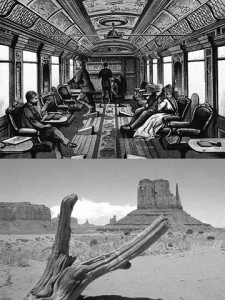 I was reading Joanna Howard’s lovely book of stories, On the Winding Stair, and thinking about the setting. And thinking about setting in general. And—for pretty obvious reasons, I suppose—was thinking about Brian Evenson’s book Dark Property. And thinking about his settings. And I was wondering if books could have soul-mates, if they could be made for each other.
My favorite work by Evenson is the stuff placed in a minimally rendered, hot, choked with dust, empty of all but the most barren of trees, flat desertscapes. His Beckett-ian Utah. His Old Surrealist West. READ MORE >
Dalkey Archive is doing their ‘we will eat your pocketbook and mind’ sale again, which I have now taken advantage of 3 times and will likely a 4th: Holiday Sale at Dalkey! Get 10 books for $65, 20 books for $120, running through November 22.
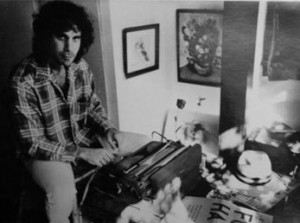
Steve Richmond, the subject of Mike Daily’s essay Gagaku Meat which I wrote about here, passed away on the 20th of October. Daily’s Richmond tribute group, Mr Viced Honest, performed for a final time on October 31.
I haven’t seen an obit anywhere. Mike, would you like to write one for us?
The following propositions have been urged: First, that some faith in our life is required even to improve it; second, that some dissatisfaction with things as they are is necessary even in order to be satisfied; third, that to have this necessary discontent it is not sufficient to have the obvious equilibrium of the Stoic. For mere resignation has neither the gigantic levity of pleasure nor the superb intolerance of pain. There is a vital objection to the advice merely to grin and bear it. The objection is that if you merely bear it, you do not grin.
–Orthodoxy, “The Eternal Revolution”
 A few months back, I talked to a painter and animator friend about craft, technique, and composition, with an ear toward what we could learn from each other’s genre. She had recently made a list of all the physical motifs that appear in her work, or in some cases her head and her life, and she read it to me. A motif, as I understand it, is different than a symbol, a metaphor, or a theme in that it simply refers to anything that recurs in a work. It doesn’t have to stand in for something else. It simply gains power and resonance through repetition, brings different parts of a composition into conversation, or provides a kind of unity to the whole.
Motifs can be physical or abstract, but I’m most interest in the tangible and sensory one–objects, landmarks, colors, sounds, and body parts. A writer or visual artist may or may not be conscious of and/or intentional in their use of motif. But my friend’s exercise, making a list of her own motifs, seems particularly exciting to me, in a way that making a list of one’s own metaphors or themes is decidedly not.
Chris Higgs interviews Kristina Born for The Faster Times, about her new book One Hour of Television. [BORN: I wanted it to be suffocating. Gertrude Stein thought (mostly in reference to her plays, I believe) that you can’t write emotional arcs, because if the reader is not in the exact right emotional state at the right stage in the arc, you’ll lose him. Her solution was to put everything on the page immediately, like a painting, and allow the reader to pick out what resonated with him at the time. I’m interested in a different solution: a complete monopoly of mood. I want to try to write in a way where the reader can pick up the book, read any sentence, and be immediately crunched down into the mood he should be in.]
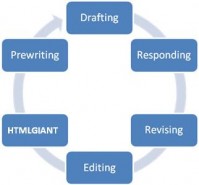 Last night in class we did some process writing. I don’t like process writing, especially when it’s rule-based. I always wonder more if I’m paying attention to the rules. Last night in class I kind of ignored the rules and the process writing. I wrote this poem. Is it any good? Is poetry better with revision? Actually, don’t answer that. Just tell me if you think this poem is good.
Q: Hey, did somebody say “Justin reviewed the new Stephen King for Bookforum?”
A: No, nobody said that.
Q: Oh, okay then.
 The very generous Walser & Co / Robert Walser Society of Western Massachusetts is giving away two limited edition Heather Christle broadsides of her poems “Vespers” and “Barnstormer” from Notnostrums and Nor By Press respectively.
What do you have to do? All you have to do is leave a comment on their blog with the name of your favorite bookstore! That’s it. Maggie the cat will randomly pick a winner. Easy, no heartburn, only the heart cola of Christle’s poetry.
Stay tuned for tomorrow afternoon, when we introduce the final poem of H.C. Week. Keep your brains full of that light stuff.